





Most couples do not actually have hundreds of different arguments. It only feels that way because the subjects keep changing. One week, the disagreement is about a forgotten text; the next, it is about housework, money, parenting, intimacy, or plans with friends.
Although the topic changes, the emotional pattern often stays remarkably familiar. One partner may feel ignored, unsupported, or unimportant, while the other feels criticized, pressured, or unable to get things right. Before long, both are reacting to each other’s reactions rather than discussing the original problem.
When this happens repeatedly, couples may be caught in a repeating conflict cycle: a predictable sequence in which an emotional trigger leads to a protective reaction, which then activates the other partner’s own fears and defences.
Understanding this pattern can help answer an important question: How do I stop repeating the same relationship argument? Instead of asking who is causing the conflict, couples can begin exploring what repeatedly happens between them, and where the cycle can be interrupted.
TL;DR: Why Do Couples Keep Having the Same Argument?
When couples keep returning to the same argument, the visible topic is often only one part of the conflict. Underneath it, one or both partners may be reacting to deeper concerns such as feeling unimportant, rejected, criticized, controlled, alone, or unable to get things right.
A repeating conflict cycle often develops like this:
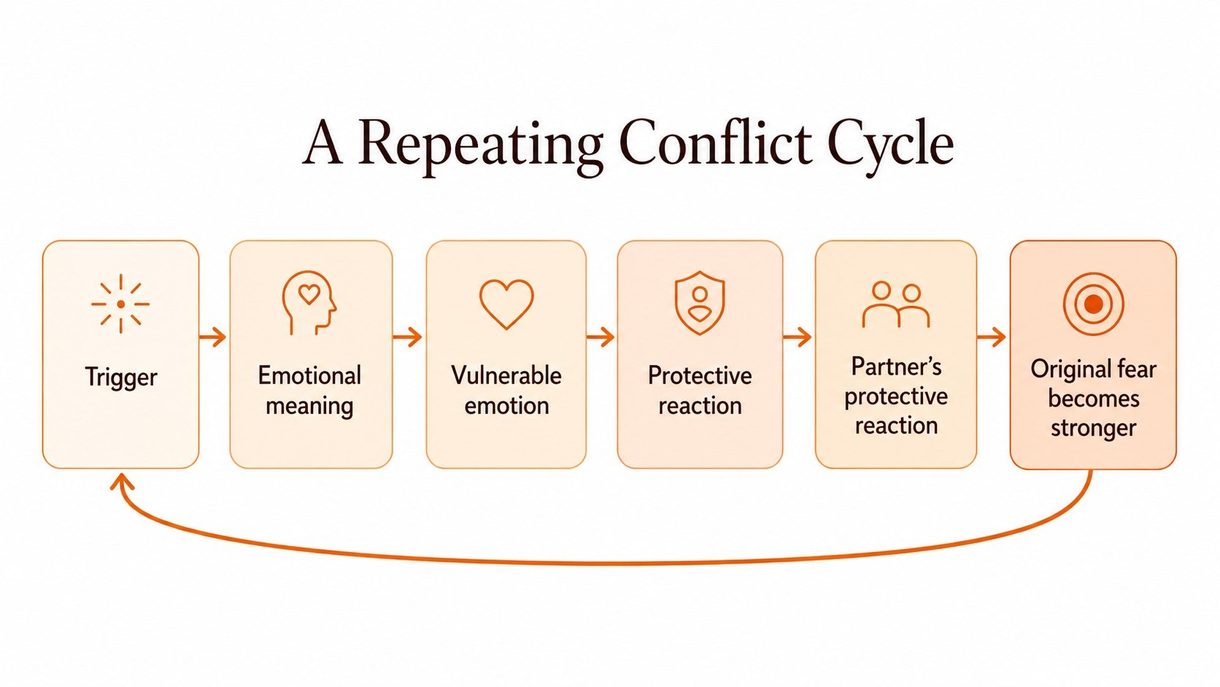
For example, one partner may experience a forgotten message as “I don’t matter to you.” They respond with criticism. The other partner hears the criticism as “I’m always disappointing you,” becomes defensive, and pulls away.
The withdrawal then confirms the first partner’s original fear. The goal is not to eliminate every disagreement. It is to learn how to recognize the cycle early enough that both partners have a chance to respond differently.
If emotions escalate quickly once conflict begins, our guide to emotional regulation skills for couples offers practical ways to stay more grounded when a conversation becomes difficult.
The Difference Between What You Are Fighting About and What the Fight Means
One of the most useful distinctions in recurring relationship conflict is the difference between the content of the argument and the process underneath it.
The Content of the Argument
The content is the obvious subject: who forgot to pay the bill, why somebody was late, whether the kitchen was cleaned, how much money was spent, whether you are having enough sex, or why your partner did not respond to a message.
These are real issues and often need practical solutions.
The Emotional Process Underneath It
The process is what happens emotionally between you while discussing the issue. Imagine that one partner arrives home an hour later than expected without sending a message. The practical problem is straightforward: they were late and did not communicate. But the emotional meaning attached to that event may be very different for each person.
One partner may experience, “I wasn’t important enough for you to think about how this would affect me.” They respond with frustration because they want their partner to understand how significant the situation felt.
The other person hears criticism and experiences something closer to, “No matter what I do, I disappoint you.” They begin explaining, minimizing, or defending themselves because they are trying to protect themselves from feeling inadequate.
Now the first partner feels even less understood, so their frustration increases. The second feels increasingly attacked and becomes even more defensive. Five minutes later, they are technically still arguing about being late, but emotionally the conversation has become about importance on one side and adequacy on the other.
Why Triggers Matter
Neither partner necessarily recognizes this while the argument is unfolding, which is why asking “How can we identify triggers causing the same argument?” can be much more productive than simply revisiting the facts of the disagreement.
Our article on relationship triggers in couples explores this process in more depth.
How Repeating Conflict Cycles Develop
A repeating conflict cycle does not usually begin because one person deliberately chooses to create tension. More often, two understandable forms of self-protection collide.
Step 1: Something Happens
Your partner looks at their phone while you are speaking.
Step 2: You Give the Moment Emotional Meaning
You think, “You’re not interested in me.”
Step 3: A More Vulnerable Emotion Appears
You may feel hurt, lonely, insecure, disappointed, or afraid.
Step 4: You Protect Yourself From That Vulnerability
Instead of saying, “I miss feeling close to you,” you say, “You’re never interested in anything I say.”
Step 5: Your Partner Experiences Your Protection as a Threat
They hear criticism rather than longing.
Step 6: They Protect Themselves
They defend, withdraw, counterattack, or become sarcastic.
Step 7: Their Reaction Confirms Your Original Fear
Now you feel even more ignored.
At this point, the cycle starts feeding itself.
The important insight is that each person’s reaction often makes sense when viewed from inside their own experience, even if the combination of those reactions is painful for the relationship.
This is why it can be more useful to talk about the couple’s pattern or dance rather than describing one person as “too needy,” “too emotional,” “too avoidant,” or “too insensitive.”
The pattern is not an excuse for hurtful behaviour, but it gives couples something more useful to work with than blame.
Three Different Arguments, One Underlying Pattern
The Argument About Housework
One partner sees laundry, dishes, appointments, and household planning piling up and says, “I have to think about everything in this house.” The other responds by listing what they have done: “I cleaned the kitchen yesterday. I picked the kids up twice this week.”
If the couple stays only at the factual level, who did more, who forgot what, whether a particular task counts, they may miss the emotional collision underneath. One partner may be trying to communicate, “I need to know I am not carrying our life alone.” The other may be hearing, “You are failing as a partner.”
The more strongly the first person tries to communicate their exhaustion, the more criticized the second feels. The more the second defends themselves, the more alone the first feels.
The Argument About Texting
One partner has not replied for several hours. Their partner becomes anxious and eventually sends another message. When the response finally arrives, the conversation starts with, “You couldn’t take ten seconds to text me?”
The person receiving the criticism experiences it as controlling and replies, “I shouldn’t have to report to you every hour.” Again, the surface disagreement is about texting frequency. Underneath it, one person may be protecting against fear of disconnection while the other is protecting against fear of losing autonomy.
The more one pursues contact, the more the other protects their independence. The more the other pulls away, the more urgently the first pursues.
The Argument About Intimacy
One partner initiates sex and is turned down. They feel rejected and become irritable or distant. Their partner notices the disappointment and starts to experience future sexual contact as increasingly loaded with pressure.
As pressure grows, desire may decline. The decrease in desire is then interpreted as further rejection.What starts as a disagreement about sexual frequency can become a cycle involving reassurance, desirability, pressure, emotional safety, and fear of disappointing one another.
In each example, practical problem-solving still matters. Couples need workable systems for chores, communication, and intimacy. But practical solutions often fail to last when the emotional process underneath remains unchanged.
Why Solving the Surface Problem Is Often Not Enough
Couples frequently say, “But we already solved this. Why are we arguing about it again?”
Sometimes the answer is that the practical agreement did not address what the disagreement represented emotionally.
A Practical Solution May Not Answer the Emotional Question
A budget can answer, “How much can we spend?” It cannot automatically answer, “Can I trust you to build a stable future with me?”
A shared calendar can answer, “Who is doing school pickup?” It may not answer, “Do you see how much responsibility I have been carrying?”
A weekly date night creates time together, but it cannot by itself answer, “Do you actually want to feel close to me?”
Both Layers Matter
This does not mean that every ordinary disagreement hides a deep attachment wound. Sometimes a missed text is simply a missed text.
The point is that recurring arguments often contain both a practical problem and an emotional meaning, and effective conflict resolution usually needs to address both.
That is also why the question “How can we finally solve our ongoing relationship argument?” may be misleading if “solve” means ensuring the topic never arises again.
In many long-term relationships, progress looks less like removing every disagreement and more like changing what happens when the disagreement returns.
The Pursuer–Withdrawer Pattern
One of the most recognizable forms of recurring conflict is the pursuer–withdrawer cycle.
What the Pursuing Partner Often Does
The pursuing partner senses distance and moves toward the relationship in an attempt to restore connection.
They may ask more questions, raise the problem repeatedly, push for reassurance, become critical, or insist that the conversation be resolved immediately.
What the Withdrawing Partner Often Does
The withdrawing partner experiences the intensity of that pursuit and moves away.
They may become quiet, explain less, change the subject, focus on another activity, or leave the conversation.
What Each Partner May Be Protecting
From outside the relationship, it can be tempting to describe one partner as demanding and the other as emotionally unavailable. Inside the pattern, however, both behaviours may be attempts to manage distress.
The pursuer may essentially be communicating, “Please show me we are okay.”
The withdrawer may be communicating, “Please reduce the intensity because I am afraid I will make this worse.”
Unfortunately, neither partner hears the underlying message clearly. The pursuer experiences withdrawal as abandonment. The withdrawer experiences pursuit as criticism or pressure. Each therefore becomes more likely to do the very thing that activates the other.
We explore this dynamic more deeply in When Love Gets Stuck: Using EFT and Polyvagal Theory to Rewire Couple Patterns.
A Step-by-Step Guide to Resolve the Same Recurring Fight
Instead of trying to analyze your entire relationship at once, choose one recent disagreement and reconstruct it after both of you are calm.
This practical exercise can help answer the question, “What steps stop us arguing about the same issue?”
Step 1: Identify the Trigger
Start with the trigger and keep it factual.
“You looked at your phone while I was talking.”
Step 2: Notice the Meaning You Attached to It
Ask what you immediately told yourself that moment meant.
Perhaps the answer is:
“You’re bored with me.”
or:
“Here we go again; nothing I do is enough.”
Step 3: Look Underneath the First Emotion
Try to identify what you felt underneath your first visible reaction.
Anger may be obvious, but was there also hurt, shame, fear, disappointment, helplessness, or loneliness?
Step 4: Identify How You Protected Yourself
Did you criticize? Explain? Pursue? Go quiet? Leave? Become sarcastic? Try to prove your point?
Step 5: Map Your Partner’s Reaction
Ask what happened to your partner when you reacted that way, and then map the same sequence from their perspective.
When couples put both versions beside each other, they often see something they could not see while arguing: one person’s self-protection became the other person’s trigger, which then created another layer of self-protection.
The exercise should not become a forensic investigation into who was worse. Its purpose is to understand the sequence well enough that one part of it can eventually change.
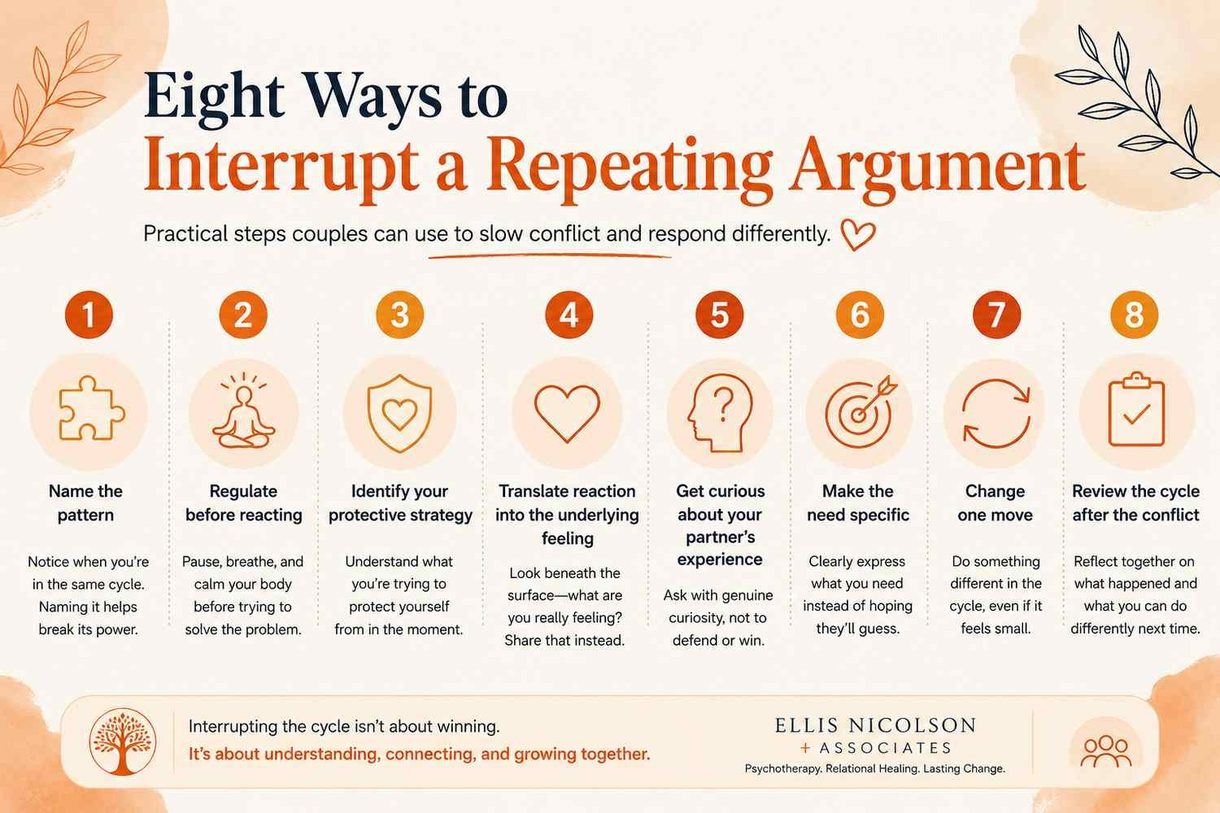
Eight Ways to Interrupt a Repeating Argument
1. Name the Pattern Before Debating the Issue
If the familiar tone, defensiveness, urgency, or withdrawal is beginning, try saying:
“I think we’re getting pulled into the same pattern again.”
That is very different from saying:
“You’re doing that thing again.”
The first makes the cycle something the two of you can observe together. The second makes your partner the problem.
2. Regulate Before Trying to Communicate Perfectly
People often search for the right sentence when they are already too emotionally activated to use any communication technique effectively.
If your heart is racing, your thoughts are becoming rigid, or you are mentally collecting evidence against your partner, slowing the conversation may be more useful than continuing it.
A healthy pause includes a commitment to return:
“I’m too activated to have this conversation well right now. I want to keep talking about it. Can we take 30 minutes and come back at eight?”
3. Identify Your Own Protective Strategy
Ask yourself what you tend to do when connection feels threatened.
Perhaps you criticize, defend, pursue, explain excessively, become sarcastic, or shut down.
If criticism, defensiveness, contempt, or stonewalling regularly appear in your conflicts, our guide to the Gottman Four Horsemen and their antidotes can help you recognize these patterns and their healthier alternatives.
4. Translate Your Reaction Into the Underlying Experience
Instead of saying, “You obviously don’t care,” you might try:
“When that happened, I felt unimportant, and I think I came at you angrily because I wanted you to understand how much it affected me.”
This is more than making the sentence sound nicer.
It allows your partner to hear the emotional information that was previously hidden underneath the accusation.
5. Become Curious About Your Partner’s Protective Reaction
Try asking:
“When I reacted that way, what happened inside you?”
You may discover that what looked like indifference was overwhelm, what looked like control was fear, or what looked like anger was shame.
Understanding a reaction does not require accepting behaviour that hurts you. It simply gives you better information about the cycle you are trying to change.
6. Make the Need Specific
One of the most useful communication techniques to end recurring arguments with your partner is turning a global complaint into a specific request.
“Care about me more” is emotionally understandable, but difficult to act on.
“If you’re running late, could you send me a quick message?” gives your partner something concrete to respond to.
Similarly, instead of, “Stop walking away from me,” try:
“If you need a break, could you tell me when you’re willing to come back to the conversation?”
7. Change One Move Rather Than Trying to Transform the Whole Relationship Overnight
Progress is often smaller and more practical than couples expect.
A pursuing partner may ask one question instead of five. A withdrawing partner may remain present long enough to say, “I’m overwhelmed, but I don’t want you to feel abandoned.”
A defensive partner may acknowledge one valid part of the complaint before explaining their own perspective.
Changing one move creates a different next move for your partner.
8. Review the Argument Once You Are Calm
After the conflict, ask where you lost one another, what each of you feared, what made the argument worse, and what might help five minutes earlier next time.
This turns conflict into information rather than another piece of evidence that the relationship is failing.
Finding It Hard to Break the Cycle on Your Own?
Repeating relationship patterns can become difficult to change once they feel automatic. Our relationship therapists can help you understand what keeps happening between you and develop healthier ways of responding when the cycle begins.
[Book a Couples Therapy Consultation]
Effective Scripts for Discussing Recurring Issues Without Arguing
Scripts are not magic formulas, and they work best when adapted to sound like you.
Still, having more precise language can be useful when you are trying to communicate differently.
When You Notice the Pattern Starting
- “I think we’re arguing about more than the actual issue right now.”
- “I’m getting defensive, and I don’t want that to stop me hearing you.”
- “Part of me wants to shut down because I feel overwhelmed. I’m still here.”
When You Are Trying to Understand the Emotion Underneath
- “When you pulled away, I told myself it meant you didn’t care. Is that what was actually happening?”
- “I think I’m pushing harder because I’m scared we’re becoming disconnected.”
- “Can we pause the debate about who is right and figure out what each of us is reacting to?”
When You Need to Slow or Repair the Conversation
- “I understand why that affected you, even though my intention was different.”
- “I need a break, but I don’t want you to experience the break as me abandoning the conversation.”
- “Can I try saying that again without attacking you?”
- “What would make this conversation feel safer for both of us?”
These kinds of phrases work best when they come after enough emotional regulation to make genuine curiosity possible.
If one or both partners are flooded, pausing may be more useful than trying to force the right words.
When Couples Therapy Can Help With Repetitive Conflict
Recurring disagreements do not automatically mean that a relationship is unhealthy. Every long-term partnership contains differences that require ongoing negotiation.
Therapy may be helpful when the pattern around those differences is creating significant distress.
Signs the Pattern May Need More Support
You may want to consider couples therapy when:
- conversations escalate quickly,
- one or both partners routinely shut down,
- resentment is increasing,
- intimacy has declined,
- past injuries repeatedly enter current arguments,
- both partners understand the pattern intellectually but still cannot interrupt it,
- or the same conflict is beginning to affect trust in the relationship itself.
How Therapy Approaches the Pattern
In couples therapy in Mississauga, our relationship therapists work not only with the subject couples are arguing about, but with the interactional pattern that makes those conversations difficult.
Approaches such as Emotionally Focused Therapy and the Gottman Method can help couples understand what happens beneath conflict, communicate more vulnerable emotions and needs, and develop new responses when familiar triggers appear.
Therapy is not about deciding which partner is right. In many cases, it is about helping the couple see the pattern clearly enough that both partners can begin responding to one another rather than reacting automatically to the cycle.
When Standard Couples Communication Strategies May Not Be Appropriate
It is important to distinguish recurring conflict from situations involving fear, coercive control, threats, or physical violence.
In those circumstances, standard couples communication exercises may not be appropriate, and safety should come first.
Frequently Asked Questions
How do I stop repeating the same relationship argument?
Start by identifying the pattern rather than focusing only on the topic. Look at what triggers the disagreement, the meaning you attach to that event, the emotion underneath your reaction, the way you protect yourself, and how that reaction affects your partner.
Once the cycle becomes visible, you can begin changing one part of it instead of replaying the entire sequence.
How can couples break the cycle of recurring fights?
Couples often break recurring cycles by slowing conflict down, recognizing triggers earlier, regulating emotional intensity, identifying the more vulnerable emotions beneath anger or defensiveness, and making clearer requests.
The aim is not to prevent every disagreement but to create a different response when familiar disagreements return.
What communication techniques prevent the same argument recurring?
Helpful techniques include softening how concerns are raised, using specific requests instead of global criticism, reflecting what you heard before defending your position, taking structured breaks when either partner is overwhelmed, validating emotional experience without pretending you agree with every interpretation, and returning to unfinished conversations after both people are calmer.
How do I resolve recurring conflicts with my partner?
Recurring conflicts usually need attention at two levels: the practical problem and the emotional process. Resolve the practical issue where possible, but also ask what the conflict represents to each of you.
If one partner experiences the issue as evidence that they do not matter while the other experiences it as evidence that they can never get anything right, solving logistics alone may not be enough.
How do I communicate needs without starting the same fight?
Try replacing accusations with the underlying experience and a specific request.
Instead of, “You never care about spending time with me,” you might say, “I’ve been feeling disconnected lately and I’d really like us to plan some time together this week.”
This makes the need easier to hear and gives your partner something concrete to respond to.
How can we identify triggers causing the same argument?
Review one recent argument when you are both calm and ask what happened immediately before the emotional shift.
Then ask what each person interpreted the event to mean.
Triggers are often connected to themes such as rejection, criticism, abandonment, control, inadequacy, or not feeling valued rather than to the event alone.
What strategies help couples move past recurring arguments?
Useful strategies include mapping the conflict cycle, regulating before problem-solving, naming protective reactions, identifying the underlying emotional need, making specific requests, using structured timeouts, repairing after conflict, and reviewing what happened afterward.
Couples therapy can also help when the pattern feels too automatic to change without support.
What steps stop us arguing about the same issue?
There is rarely one technique that ends a recurring disagreement permanently.
A more realistic sequence is to identify the trigger, recognize your interpretation, notice the vulnerable emotion underneath your reaction, understand how you protect yourself, learn how that affects your partner, communicate the need more clearly, and make a practical agreement that addresses the surface problem as well.
You Don’t Have to Keep Having the Same Argument
When the same conflict returns again and again, it can begin to feel as though nothing either of you says will make a difference.
Recurring arguments, however, do not necessarily mean that the relationship is fundamentally incompatible. Often, they are a sign that two people have become caught in a pattern that neither knows how to interrupt once the emotional intensity begins.
How Ellis Nicolson + Associates Can Help?
At Ellis Nicolson + Associates, our relationship therapists help couples slow these patterns down, understand the emotions and needs underneath them, and develop new ways of communicating and reconnecting.
Drawing from approaches including Emotionally Focused Therapy and the Gottman Method, we focus not only on what you are arguing about, but on what repeatedly happens between you when conflict begins.
If you are tired of revisiting the same disagreement and want help finding a different way forward, contact Ellis Nicolson + Associates to book a couples therapy consultation.
You can also learn more about our approach to couples therapy in Mississauga and how we help couples understand and change recurring relationship patterns.