





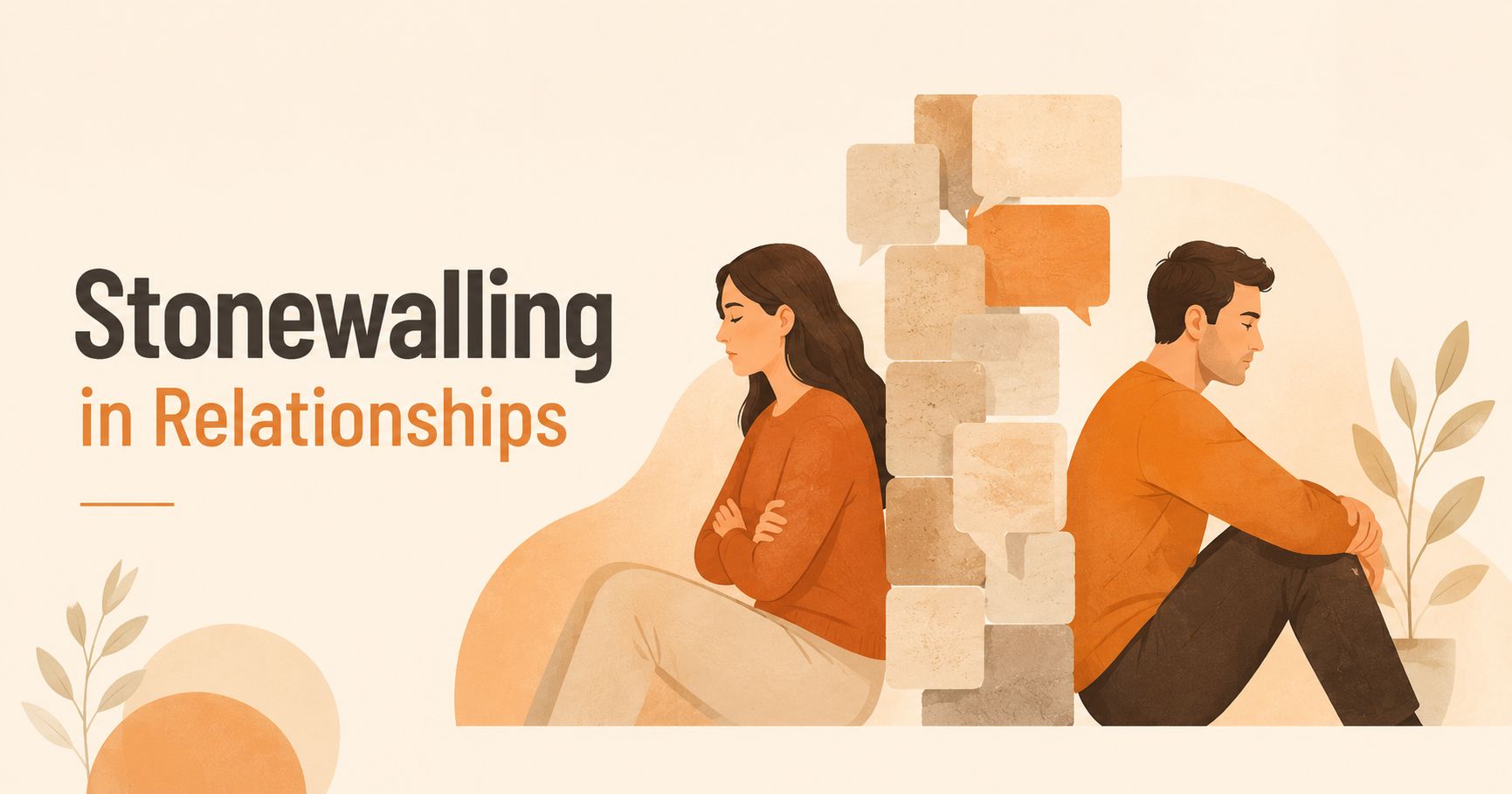
You are trying to explain why something hurt you, but your partner suddenly becomes quiet. Their answers get shorter. They avoid eye contact, look at their phone, leave the room, or simply stop responding.
The more you try to reconnect, the further away they seem to go.
This pattern is often described as stonewalling in relationships. And while it can feel like indifference or rejection to the partner on the receiving end, stonewalling is not always as simple as someone refusing to communicate. Sometimes people withdraw deliberately. In other situations, they become so emotionally overwhelmed that continuing the conversation feels almost impossible.
That is why an important distinction needs to be made from the beginning: not every request for space is stonewalling. Healthy couples sometimes need to pause difficult conversations. The difference is whether the pause is communicated, whether both partners feel emotionally considered, and whether the conversation is eventually resumed.
Understanding what happens underneath stonewalling can help couples move from a painful pursue-and-withdraw cycle toward healthier conflict, emotional safety, and reconnection.
Table of Contents
TL;DR: What Is Stonewalling in a Relationship?
Stonewalling happens when one partner repeatedly disengages from communication during conflict. It might involve silence, avoiding eye contact, leaving the room, refusing to answer questions, changing the subject, or becoming emotionally unavailable.
Stonewalling can be intentional, but it can also happen when someone becomes emotionally flooded and no longer feels capable of communicating productively. A healthy timeout sounds different:
“I want to continue this conversation, but I’m overwhelmed right now. Can we take 30 minutes and come back to it?”
That communicates three things:
I need space. I still care about this conversation. I am coming back.
Those three messages can make the difference between healthy emotional regulation and withdrawal that leaves a partner feeling abandoned.
What Are the Main Signs of Stonewalling Behavior?
The main signs of stonewalling behavior involve repeatedly withdrawing from emotional or verbal engagement when conflict arises.
A partner who is stonewalling may:
- stop responding during arguments
- give very short answers such as “fine,” “whatever,” or “I don’t know”
- avoid eye contact
- turn their body away
- suddenly focus on their phone, television, or another activity
- leave without explaining when they will return
- refuse to discuss certain relationship issues
- change the subject whenever conflict becomes uncomfortable
- appear emotionally absent
- repeatedly postpone conversations without returning to them
The key word is pattern. Someone needing ten minutes to calm down after an unusually stressful conversation does not automatically mean they are stonewalling. The concern is when withdrawal repeatedly prevents the couple from discussing problems, expressing needs, repairing conflict, or feeling emotionally connected.
Stonewalling is also one of the communication patterns identified within the Gottman Method’s Four Horsemen. You can learn more about how these behaviors interact in our guide to the Gottman Four Horsemen and their antidotes.
Why Does My Partner Shut Down and Stonewall Me?
There is rarely one universal reason.
Sometimes withdrawal is used to avoid responsibility or control the direction of a conversation. But in many relationships, stonewalling develops because one partner becomes emotionally overwhelmed.
During an intense disagreement, the nervous system can enter a heightened state of stress. A person may find it difficult to process what their partner is saying, organize their thoughts, regulate their emotions, or respond empathically.
Their internal experience may sound like:
I don’t know what to say.
Everything I say makes this worse.
I need this conversation to stop.
I can’t think clearly.
I just want to get away.
From the other side, however, that same behavior may communicate something completely different:
You don’t care about me.
You’re ignoring me.
My feelings don’t matter.
This difference in emotional experience is one reason stonewalling can become such a powerful relationship cycle.
Stonewalling vs. Taking Healthy Space
Taking space during conflict can actually be healthy.
The difference lies in communication, reassurance, and return.
| Stonewalling | Healthy Timeout |
| Withdrawal happens without explanation | The need for space is communicated |
| The partner is left uncertain | Reassurance is provided |
| There is no plan to continue | A time to reconnect is agreed upon |
| Silence may feel punishing | The break is used for emotional regulation |
| Difficult issues remain chronically unresolved | The couple returns to the issue |
| Withdrawal increases distance | The pause protects the conversation |
Instead of:
“I’m done talking.”
A healthier alternative might be:
“I can feel myself shutting down. I need a little time, but I don’t want to leave this unresolved. Can we come back to it after dinner?”
Learning these kinds of responses is part of developing stronger emotional regulation skills for couples.
How Do I Stop Stonewalling in My Relationship?
The first step is learning to recognize stonewalling before complete shutdown occurs.
Pay attention to what happens in your body and thoughts during conflict.
You may notice:
- increased heart rate
- shallow breathing
- tense shoulders or jaw
- difficulty concentrating
- feeling trapped
- wanting to escape
- thinking “there’s no point”
- becoming unusually quiet
- struggling to understand what your partner is saying
Once you recognize those signals, try replacing sudden withdrawal with communication.
For example:
“I’m getting overwhelmed and I don’t want to shut down. I need a short break.”
Stopping stonewalling does not mean forcing yourself to continue every conversation regardless of how distressed you feel.
It means learning to pause without disconnecting.
Practical Steps to Stop Stonewalling in Relationships
A simple process can help couples interrupt the pattern.
1. Recognize your early warning signs
Notice when you are approaching emotional overload rather than waiting until communication becomes impossible.
2. Say what is happening
Tell your partner you are overwhelmed instead of suddenly withdrawing.
3. Reassure the relationship
Clarify that needing space does not mean you are abandoning your partner or avoiding the issue permanently.
4. Set a time to reconnect
Replace “later” with something concrete whenever possible.
For example:
“Can we continue this conversation at 7:30?”
5. Regulate rather than rehearse
Use the break to calm your nervous system.
Walk, stretch, breathe slowly, listen to music, shower, or do something grounding.
Try not to spend the entire break mentally building your case against your partner.
6. Return when you said you would
Returning is what transforms withdrawal into a healthy timeout.
7. Start more gently
When you resume the conversation, avoid immediately returning to accusation or criticism.
Try describing what happened and what you need instead.
Step by Step Plan to Overcome Stonewalling Patterns
For couples who experience stonewalling frequently, it can help to create a shared agreement outside of conflict.
A step-by-step plan might look like this:
Step 1: Identify the situations most likely to trigger shutdown.
Step 2: Agree on a phrase either partner can use when becoming overwhelmed.
Step 3: Decide what a healthy timeout looks like.
Step 4: Agree that requesting a break will not automatically be interpreted as rejection.
Step 5: Agree that the withdrawing partner will return to the conversation.
Step 6: Resume difficult conversations using slower, less accusatory language.
Step 7: Reflect afterward on what helped and what made the conversation harder.
Over time, this changes the meaning of a pause.
Instead of:
“You are leaving me.”
It becomes:
“We are trying to protect this conversation so we can handle it better.”
How to Communicate With a Partner Who Stonewalls?
If your partner tends to shut down, increasing pressure may unintentionally make withdrawal stronger.
Repeatedly asking:
“Why aren’t you answering me?”
“Say something!”
“You’re doing this again!”
may feel understandable when you are desperate for connection, but it can make an overwhelmed partner retreat even further. Instead, try naming what you are observing without attacking:
“I can see this conversation is becoming difficult. Do you need a break?”
You can also make your own need clear:
“I’m okay taking some space, but I need us to agree on when we’ll continue this conversation.”
This allows both partners’ needs to exist at the same time. One person may need space, and the other may need reassurance that the relationship has not suddenly disappeared.
How to Respond Calmly When Being Stonewalled?
Being on the receiving end of stonewalling can trigger powerful emotions, particularly if withdrawal makes you feel ignored, rejected, or abandoned.
Before continuing to pursue the conversation, try noticing your own reaction.
Ask yourself:
What am I afraid this silence means?
Perhaps the underlying fear is:
They don’t care.
We’re never going to resolve this.
I’m alone in this relationship.
Recognizing the emotional meaning of the moment can help you respond rather than react.
You might say:
“I don’t want to pressure you, but silence is difficult for me. If you need a break, can you tell me when we can continue?”
Understanding your own relationship triggers can make these moments easier to navigate.
What Boundaries Should I Set Around Stonewalling Behavior?
Healthy boundaries should respect someone’s need to regulate their emotions without requiring you to accept indefinite avoidance.
A reasonable boundary might sound like:
“I respect that you sometimes need space during conflict. I cannot continue having important conversations disappear completely. If we pause, I need us to agree on when we will revisit the issue.”
Another might be:
“I’m willing to continue this conversation when we can both speak respectfully. I’m going to step away if we begin insulting or intimidating each other.”
Boundaries are not threats designed to force another person to behave differently.
They communicate what you will participate in, what you need for emotional safety, and what you will do if a conversation becomes unhealthy.
Conflict Resolution Strategies for Relationships With Stonewalling
Stonewalling often exists within a broader conflict cycle.
One partner withdraws.
The other becomes more urgent.
That increased urgency causes further withdrawal.
Eventually both partners become more distressed, and the original problem becomes almost impossible to discuss.
This is why couples may feel like they are having the same argument over and over.
Helpful conflict resolution strategies include:
- beginning difficult conversations gently
- discussing one issue at a time
- avoiding criticism of your partner’s character
- identifying emotional flooding early
- taking structured breaks
- validating before problem-solving
- talking about underlying emotions rather than only surface complaints
- returning to unresolved conversations
- repairing after conflict
The goal is not to eliminate disagreement. It is to create a relationship in which disagreement does not automatically lead to attack, withdrawal, or emotional disconnection.
Best Communication Exercises for Couples Dealing With Stonewalling
Simple communication exercises can help couples practice staying emotionally present.
The Speaker-Listener Exercise
One partner speaks for a few minutes while the other listens without interrupting.
The listener then summarizes:
“What I hear you saying is…”
The speaker can clarify before roles switch.
Name the Emotion
Instead of focusing exclusively on what your partner did, complete the sentence:
“When this happens, I feel…”
Try moving beyond anger toward emotions such as hurt, fear, loneliness, shame, or disappointment.
The Timeout Agreement
Practice your timeout language when you are not arguing.
Agree on:
- how to request a break
- how reassurance will be given
- how long the break might last
- how you will decide when to reconnect
The Repair Question
After a difficult conversation, ask:
“What could we each do differently next time?”
The goal is curiosity rather than blame.
How Can I Repair Trust After Stonewalling Episodes?
Trust is rarely repaired through one perfect conversation.
It is rebuilt through repeated experiences of emotional reliability.
For the partner who tends to withdraw, repair may involve acknowledging the impact:
“I understand that disappearing during conflict made you feel alone. I want to handle that differently.”
Then follow that apology with behavioral change.
Take breaks when necessary—but return.
Communicate instead of disappearing.
Listen even when the conversation is uncomfortable.
For the partner who tends to pursue, repair may mean learning to respect clearly communicated breaks rather than interpreting every pause as abandonment.
Both partners gradually learn:
We can become upset and still find our way back to each other.
The Gottman and EFT Perspectives on Stonewalling
The Gottman Method identifies stonewalling as one of the Four Horsemen, alongside criticism, contempt, and defensiveness.
From this perspective, one important intervention involves recognizing physiological overwhelm and learning to self-soothe before returning to the discussion.
Emotionally Focused Therapy, or EFT, often looks at the deeper emotional cycle between partners.
A common pattern is pursue-withdraw. One partner may criticize, question, or push for reassurance because they fear disconnection.
The other withdraws because they feel overwhelmed, inadequate, criticized, or afraid that anything they say will worsen the conflict. The more one pursues, the more the other withdraws.
And the more one withdraws, the more desperately the first person pursues. Therapy helps couples stop seeing each other as the enemy and start recognizing the cycle itself as the problem.
What Is the Best Therapy for Stonewalling Couples?
There is no single therapy approach that is automatically best for every couple. However, couples therapy approaches that directly address emotional regulation, attachment, communication, and negative interaction cycles can be particularly useful.
Emotionally Focused Therapy (EFT) helps couples understand the emotions and attachment needs underneath patterns such as pursuing and withdrawing.
The Gottman Method provides practical tools for identifying destructive conflict patterns, reducing emotional flooding, improving repair attempts, and communicating more effectively.
The most important factor is finding a couples therapist who can understand the pattern between both partners, rather than simply identifying one person as the problem.
Effective Relationship Coaching for Chronic Stonewalling Issues
People searching for relationship coaching for chronic stonewalling may actually benefit more from couples psychotherapy when the pattern involves longstanding emotional distress, attachment injuries, recurring conflict, or significant relationship disconnection.
Coaching tends to focus more heavily on goals, skills, and future behavior. Psychotherapy can explore both practical communication skills and the emotional experiences underneath the pattern.
For couples who repeatedly find themselves trapped in pursuit, withdrawal, criticism, defensiveness, or unresolved conflict, working with a trained couples therapist may offer a more comprehensive approach.
Signs of Emotional Abuse and Stonewalling in Relationships
Stonewalling and emotional abuse are not automatically the same thing.
Someone becoming overwhelmed and asking for a break is very different from deliberately using silence, withdrawal, or abandonment to punish or control another person.
More concerning patterns may include:
- intentionally withholding communication to punish a partner
- repeatedly disappearing to create fear or uncertainty
- using prolonged silence as leverage
- combining withdrawal with threats, humiliation, intimidation, or controlling behavior
- refusing communication specifically to gain power over the other person
Context matters.
Calling every period of silence “abuse” can oversimplify complicated relationship dynamics. At the same time, persistent patterns of intimidation, coercion, punishment, or control should be taken seriously.
10 Things to Say Instead of Stonewalling
When your mind goes blank during conflict, having prepared language can help.
- “I’m getting overwhelmed, but I don’t want to avoid this.”
- “I need a short break so I can listen properly.”
- “Can we pause for 30 minutes and continue afterward?”
- “I care about this conversation even though I’m struggling right now.”
- “I can feel myself shutting down.”
- “I’m not ready to answer well yet. Can I think about it?”
- “Can we slow this conversation down?”
- “I need some space, but I’m not leaving the issue unresolved.”
- “I know breaks can feel difficult for you. I will come back.”
- “We’re both getting overwhelmed. Can we reset and try again?”
When to Seek Couples Therapy for Stonewalling?
Consider professional support when stonewalling:
- happens during most difficult conversations
- repeatedly prevents conflict from being resolved
- has created significant loneliness or resentment
- occurs alongside criticism, contempt, or defensiveness
- causes one partner to stop expressing their needs
- has continued despite repeated attempts to change
- makes either partner feel emotionally unsafe or chronically disconnected
At Ellis Nicolson + Associates, our relationship therapists work with couples who feel stuck in recurring patterns of conflict, shutdown, emotional distance, and disconnection. Rather than simply focusing on who starts the argument or who withdraws, couples therapy can help you understand what happens between you, what each partner is trying to protect, and how to build a safer way of communicating.
If stonewalling has become part of your relationship’s normal conflict pattern, you do not have to keep repeating the same cycle. Explore our couples therapy in Mississauga to learn more about how we work with couples and schedule an initial consultation.
Frequently Asked Questions About Stonewalling in Relationships
Is stonewalling always intentional?
No. Some people deliberately withdraw from conversations, but others shut down automatically when they become emotionally overwhelmed.
Is asking for space during an argument stonewalling?
Not necessarily. A healthy timeout includes communication, reassurance, and an intention to return. Repeatedly disappearing or refusing to revisit important issues is more concerning.
Can stonewalling ruin a relationship?
Chronic stonewalling can create loneliness, resentment, and emotional distance because important relationship issues remain unresolved. However, couples can learn different ways of managing conflict.
How long should a break during an argument last?
The exact amount of time varies. The important part is allowing enough time to calm down and agreeing on when the conversation will continue.
Should I follow my partner when they walk away?
If your partner has clearly communicated a reasonable need for a timeout, following them and insisting they continue talking may increase emotional flooding. Agree instead on when you will reconnect.
Can both partners stonewall?
Yes. Couples do not always have fixed roles. One partner may withdraw during one type of conflict while the other withdraws in different situations.
Does stonewalling mean my partner does not love me?
Not necessarily. Withdrawal can result from overwhelm, fear of conflict, shame, difficulty expressing emotions, or learned relationship patterns. What matters is whether the couple can acknowledge the pattern and work toward healthier communication.
Can couples therapy help with stonewalling?
Yes. Couples therapy can help identify the cycle surrounding stonewalling, improve emotional regulation, uncover underlying emotions, and teach partners safer ways to pause and reconnect during conflict.