





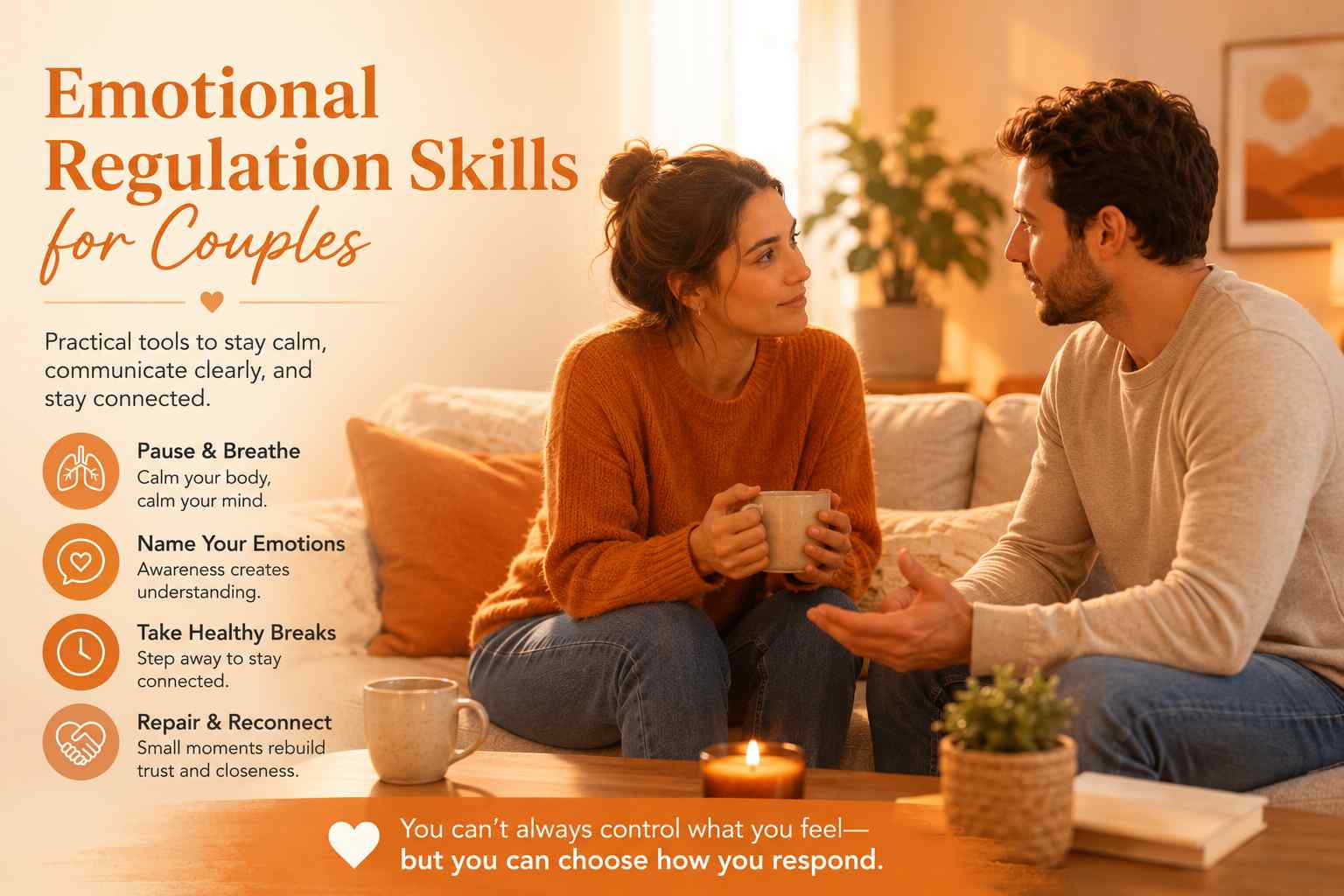
Emotions can intensify quickly during relationship conflict. A small disagreement about chores, plans, or tone of voice can suddenly feel like rejection, criticism, or proof that your partner does not understand you.
When this happens, the goal is not to stop feeling or force yourself to remain calm. Emotional regulation skills help you recognize what is happening inside you, reduce the intensity of your reaction, and choose a response that supports both you and your relationship.
These skills can be learned and strengthened with practice. You do not need to regulate perfectly before discussing difficult subjects with your partner. Even a brief pause, a slower breath, or a more accurate description of what you feel can change the direction of a conversation.
TL;DR: Emotional Regulation Skills for Couples
- Emotional regulation means noticing, understanding, and responding to emotions without automatically acting on them.
- Regulation is not the same as suppressing, ignoring, or controlling every feeling.
- Useful tools include naming the emotion, noticing physical signals, pausing, breathing slowly, checking your interpretation, and clearly communicating your needs.
- Couples can practise emotional regulation together, but each person remains responsible for their own behaviour.
- If emotions regularly become overwhelming or lead to shutdown, aggression, panic, or repeated destructive conflict, an emotional regulation therapist can help.
- CBT, DBT, ACT, mindfulness-based therapy, EFT, and other approaches may support healthier emotional regulation.
What Are Emotional Regulation Skills?
Emotional regulation skills are strategies that help you notice, understand, tolerate, and respond to emotional experiences in healthier ways.
In psychology and therapy, emotion regulation generally refers to the processes people use to influence which emotions they experience, when they experience them, and how they express or respond to them.
Regulation does not mean eliminating uncomfortable feelings. Anger, anxiety, sadness, disappointment, and jealousy can all provide useful information. The skill lies in listening to that information without allowing the emotion to dictate your next action.
For example, emotional regulation may help you move from:
“You clearly don’t care about me. You never listen.”
to:
“I’m feeling dismissed and becoming defensive. I need a moment to calm down, and then I want to explain why this matters to me.”
The emotion has not disappeared. However, it is being expressed in a way that makes understanding and repair more possible.
Is Emotional Regulation a Skill or a Cognitive Ability?
Emotional regulation is a collection of learnable skills rather than a single fixed ability.
Some regulation strategies rely on cognitive skills, including attention, self-awareness, impulse control, perspective-taking, and the ability to reconsider an initial interpretation. Other strategies work through the body, behaviour, environment, or connection with another person.
For example:
- Cognitive regulation may involve questioning the thought, “My partner is late because I’m not important.”
- Physical regulation may involve slowing your breathing and releasing tension from your shoulders.
- Behavioural regulation may involve taking a planned break instead of sending an angry message.
- Interpersonal regulation may involve asking your partner for reassurance, space, or a calmer tone.
Because emotional regulation involves several processes, a person may be strong in one area and struggle in another. You might understand your emotions well but find it difficult to calm your body during conflict. Alternatively, you might remain outwardly composed while suppressing feelings until they emerge later.
Why Emotional Regulation Matters in Relationships
Romantic relationships can activate some of our deepest emotional sensitivities. A partner’s distraction may feel like rejection. Constructive feedback may sound like criticism. A change of plans may activate fears of abandonment or losing control.
When emotional arousal becomes intense, couples may fall into recurring patterns:
- One partner pursues while the other withdraws.
- Both partners become defensive and try to prove who is right.
- One person shuts down while the other becomes increasingly distressed.
- The original issue is replaced by criticism, blame, or old grievances.
- One or both partners say things they later regret.
Difficulty regulating emotions has been associated with less constructive conflict patterns and lower relationship satisfaction. Conversely, learning to reduce emotional intensity can make it easier to listen, communicate and solve the actual problem.
Emotional Regulation Skills Toolkit for Couples
The following emotional regulation skills toolkit offers practical techniques couples can use to manage intense feelings, communicate more clearly, and navigate conflict together.
| Skill | What to do | When it helps | Example |
| Name the emotion | Identify the specific feeling rather than saying you feel “bad” or “upset.” | When emotions feel confusing or overwhelming | “I feel embarrassed and afraid of being judged.” |
| Notice body signals | Scan for a tight chest, clenched jaw, racing heart, heat, nausea, or shallow breathing. | Before your reaction becomes too intense | “My shoulders are tense, so I may be getting defensive.” |
| Pause before responding | Wait several seconds before speaking, replying, or sending a message. | When you feel an urge to attack, defend, or withdraw | “Give me a moment to think about what I want to say.” |
| Extend the exhale | Breathe gently and make the exhale slightly longer than the inhale. | When your body feels activated | Inhale for four counts and exhale for six, without forcing the breath. |
| Check the story | Separate observable facts from assumptions about your partner’s intentions. | When anxiety or anger is based on mind-reading | “They haven’t replied yet. I don’t know why.” |
| Use cognitive reappraisal | Look for a more balanced interpretation without dismissing your feelings. | When your first interpretation intensifies distress | “This may be forgetfulness, not proof that I don’t matter.” |
| Ask for what you need | Make a clear, realistic request instead of expecting your partner to guess. | When resentment or helplessness is building | “Could you tell me when you need more time to respond?” |
| Take a structured break | Agree to pause and specify when you will return to the conversation. | When either partner is too overwhelmed to listen | “Let’s take 20 minutes and continue at 7:30.” |
| Practise self-validation | Acknowledge that your emotional response makes sense in context. | When shame about being emotional intensifies the reaction | “This touched an old fear. I can be kind to myself while I calm down.” |
| Focus on repair | Use a small gesture to reduce tension and restore connection. | When the conversation is becoming adversarial | “I’m not against you. Can we restart more gently?” |
How to Quickly Improve Emotional Regulation During Conflict
When emotions are already intense, complicated exercises can be difficult to remember. Use this short sequence instead.
1. Stop the automatic reaction
Do not immediately send the message, raise your voice, threaten to leave, or force the discussion to continue. Create a small gap between the feeling and the action.
2. Identify what is happening
Ask yourself:
- What emotion am I experiencing?
- What is happening in my body?
- What am I afraid this situation means?
- What am I tempted to do?
Try to be specific. “I feel angry” may become, “I feel hurt, excluded, and afraid I am not a priority.”
3. Lower the physical intensity
Slow your breathing, place both feet on the floor, relax your hands, or briefly change your environment. The purpose is not to erase the emotion but to bring it into a range you can manage.
4. Examine your interpretation
Ask, “What do I know, and what am I assuming?”
Your fear may be understandable without your interpretation being completely accurate. Cognitive reappraisal, changing how you interpret a situation, can be more helpful than simply hiding emotional expression.
5. Choose a relationship-supporting response
Decide what would help you move toward understanding, safety, or problem-solving. That may mean making a request, setting a boundary, taking a break, apologizing, or listening before explaining your position.
Emotional Regulation Skills for Anger Management
Anger often appears quickly, but it may be protecting more vulnerable emotions such as fear, shame, hurt, powerlessness, or rejection.
When anger rises, try asking:
- What happened immediately before I became angry?
- What boundary, expectation, or emotional wound feels threatened?
- What am I trying to make my partner understand?
- Can I express that without insulting, intimidating, or punishing them?
A helpful anger-management script is:
“I’m becoming very angry, and I don’t want to speak to you disrespectfully. I need a short break. I will come back at 8:00 so we can continue.”
A break is most effective when it is used for regulation, not rehearsing arguments, and when the partner clearly commits to returning. Walking away indefinitely can feel like abandonment or punishment rather than healthy emotional regulation.
If anger involves threats, intimidation, breaking objects, physical aggression, or fear for anyone’s safety, ordinary communication tools are not sufficient. Seek appropriate professional and safety support.
Book a consultation
How to Build Emotional Regulation Skills Over Time
If you are wondering how to learn emotional regulation skills, consistency matters more than trying to master everything at once.
Start with this step-by-step practice:
- Track your triggers. Record the situation, emotion, body sensations, thoughts, impulses, and eventual response.
- Expand your emotional vocabulary. Learn to distinguish irritation from resentment, guilt from shame, and sadness from loneliness.
- Practise while calm. Breathing, grounding, and communication tools are easier to access during conflict when they are already familiar.
- Identify recurring interpretations. Look for patterns such as “I’m not important,” “I’ll be abandoned,” or “I’m never good enough.”
- Choose one replacement response. For example, replace accusatory texts with a 10-minute pause and a direct request.
- Review what happened without shame. Ask what helped, what intensified the reaction, and what you could try next time.
- Practise as a couple. Agree on break rules, repair phrases, boundaries, and ways to signal emotional overload.
This same process can help people develop emotional regulation skills after burnout. However, burnout may reduce the energy available for self-control, reflection, and communication. Rest, reduced demands, predictable routines, and realistic expectations may need to come before more demanding emotional work.
Emotional Regulation for Anxiety and Highly Sensitive People
Highly sensitive or anxious people may notice subtle changes in tone, facial expression, availability, or routine. This sensitivity is not inherently unhealthy, but it can become exhausting when every change is interpreted as danger.
Helpful regulation tools include:
- Reducing sensory stimulation before difficult conversations
- Asking for clarification instead of relying on assumptions
- Scheduling demanding discussions rather than beginning them unexpectedly
- Using grounding exercises during rumination
- Limiting repeated reassurance-seeking
- Separating emotional intensity from certainty
- Allowing additional recovery time after conflict
Try saying:
“I’m noticing anxiety, and my mind is filling in the gaps. Could you clarify what you meant?”
This honours the emotional experience without treating an anxious interpretation as established fact. Learn more about anxiety therapy and how it can help.
What Does an Emotional Regulation Therapist Do?
An emotional regulation therapist helps clients understand emotional patterns, tolerate distress, interrupt rumination, communicate more effectively, and develop healthier coping responses.
Depending on your needs, therapy may explore current triggers, relationship dynamics, learned beliefs, attachment patterns, trauma, anxiety, burnout, or earlier experiences in which emotions were ignored or punished.
Common therapy approaches for improving emotional regulation include:
- Cognitive behavioural therapy (CBT): Helps identify and change unhelpful thoughts and behaviours.
- Dialectical behaviour therapy (DBT): Teaches mindfulness, distress tolerance, emotion regulation, and interpersonal effectiveness.
- Acceptance and commitment therapy (ACT): Builds psychological flexibility and helps people act according to their values while allowing difficult emotions to exist.
- Mindfulness-based approaches: Develop awareness of thoughts, emotions, and physical sensations without immediate reaction.
- Emotionally focused therapy (EFT): Helps couples identify vulnerable emotions and change recurring patterns of disconnection.
- Trauma-informed therapies: May help when dysregulation is connected to traumatic experiences or persistent threat responses.
There is no single best approach for every person. The most effective strategy depends on the emotion, situation, history, goals, and level of distress.
When to Seek Support
Consider speaking with a therapist when emotional reactions:
- Feel consistently overwhelming or impossible to interrupt
- Regularly damage your relationship
- Lead to prolonged rumination, panic, withdrawal, or explosive anger
- Affect your work, sleep, health, or daily functioning
- Are connected to trauma, anxiety, depression, or burnout
- Continue despite your efforts to use self-help tools
At Ellis Nicolson + Associates, our relationship and anxiety specialists help individuals and couples understand difficult emotional patterns and develop healthier ways to manage conflict, anxiety, and disconnection. Contact us or book a consultation to learn how therapy can support you or your relationship.
Frequently Asked Questions About Emotional Regulation Skills
How can adults quickly improve their emotional regulation skills?
Start by pausing before reacting, naming the specific emotion, noticing physical signs of activation, and slowing your breathing. Then separate what you know from what you are assuming and choose a response that supports your immediate needs and longer-term goals.
What are the best emotional regulation skills for managing daily stress?
Helpful skills include mindful breathing, emotional labeling, grounding, self-compassion, cognitive reappraisal, realistic problem-solving, and setting healthy boundaries. Regular sleep, movement, restorative breaks, and reduced overstimulation can also make emotions easier to manage.
What is a step-by-step guide to mastering emotional regulation?
Begin by identifying your triggers, recognizing how emotions appear in your body, and noticing the thoughts that intensify them. Practise calming your physical response, reconsidering automatic interpretations, communicating your needs clearly, and reviewing what helped afterward. Emotional regulation is an ongoing practice rather than a skill anyone must perform perfectly.
Which emotional regulation skills support anger management?
Useful anger-management skills include recognizing early warning signs, pausing before responding, taking a structured break, slowing your breathing, and identifying the vulnerable emotion beneath the anger. Expressing a clear need or boundary is generally more constructive than blaming, threatening, or suppressing the feeling.
What does evidence-based emotional regulation skills training for anxiety involve?
Training may include techniques drawn from CBT, DBT, ACT, mindfulness-based therapies, and other evidence-informed approaches. Depending on the person, it may focus on identifying anxious thoughts, tolerating uncertainty, reducing avoidance, grounding the body, and responding more flexibly to emotional discomfort.
What are practical emotional regulation skills for high-functioning professionals?
High-functioning professionals may benefit from scheduled recovery time, brief grounding exercises between tasks, clear work boundaries, realistic prioritization, and noticing when productivity is being used to avoid difficult feelings. Pausing before sending emotionally charged messages can also prevent stress from affecting professional relationships.
How to develop emotional regulation skills after burnout?
Begin by reducing unnecessary demands and supporting basic recovery through rest, nourishment, predictable routines, and manageable expectations. Once some capacity returns, practise emotional check-ins, gentle grounding, boundary-setting, and responding to signs of overwhelm before they become severe.
Which emotional regulation skills are useful for highly sensitive people?
A helpful toolkit may include reducing sensory overload, planning recovery time, grounding through the senses, asking for clarification, and separating emotional intensity from certainty. Highly sensitive people may also benefit from preparing for difficult conversations and communicating their need for a slower pace or calmer environment.