






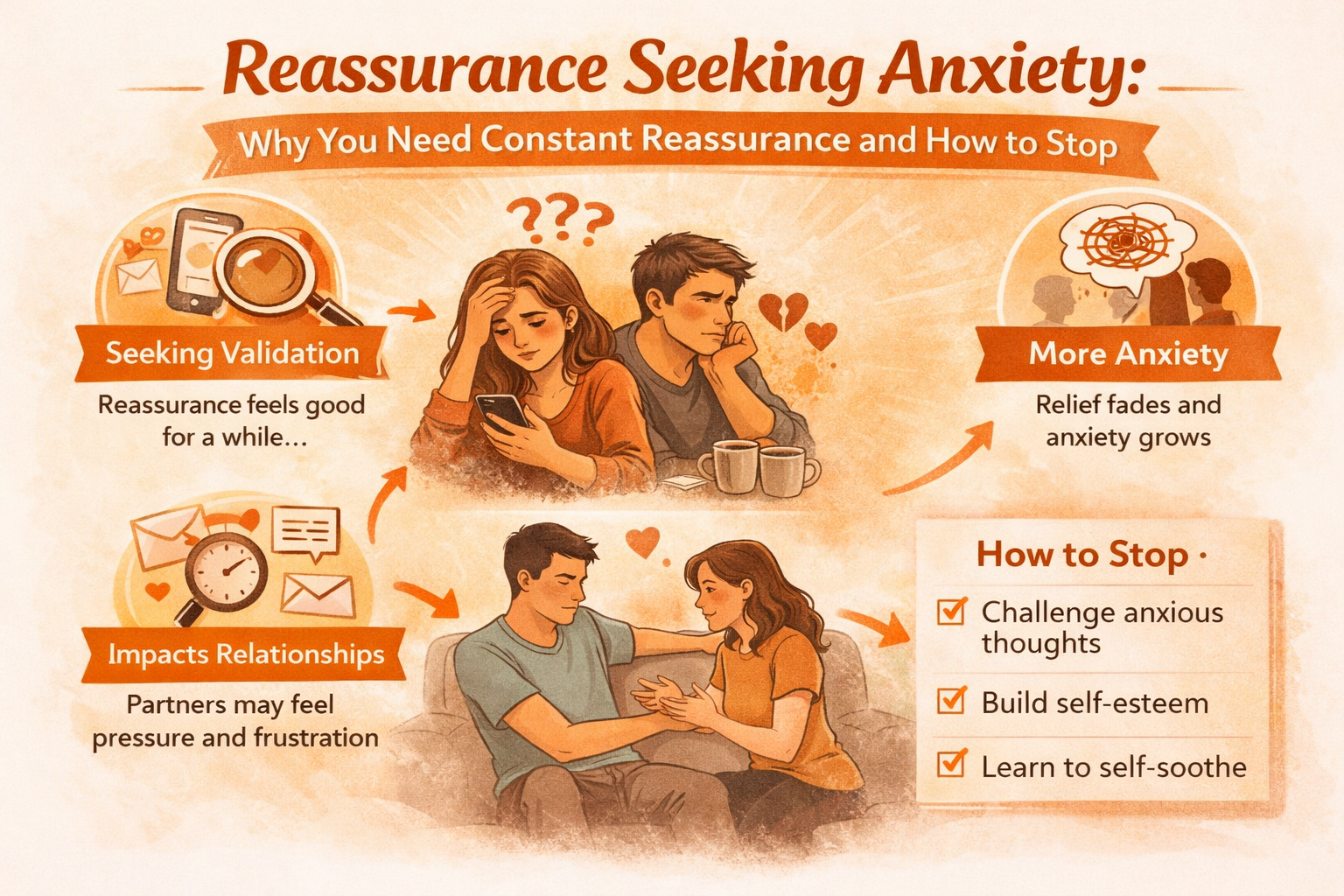
If you have ever found yourself asking, why do I need so much reassurance, why do I need constant reassurance, or why do I always need reassurance in relationships, you are not alone. Reassurance seeking anxiety is a common pattern, especially when fear of disconnection, rejection, or “getting it wrong” gets activated. A delayed text, a different tone of voice, or a partner seeming distracted can quickly spiral into overthinking, checking, and repeated questions.
The painful part is that reassurance usually works, but only briefly. You ask, “Are we okay?” or “Are you mad at me?” You feel calmer for a moment. Then doubt creeps back in. That is why reassurance seeking and anxiety often become so tightly linked. The very thing that brings short-term relief can keep long-term anxiety alive.
This does not mean your needs are too much. It means your nervous system may have learned to look for certainty as a way to feel safe. The goal is not to become cold, detached, or perfectly self-sufficient. The goal is to learn how to stop seeking reassurance in ways that strengthen trust, emotional regulation, and connection rather than feeding fear. If this pattern shows up often, our post on relationship anxiety may also be helpful.
What is reassurance seeking anxiety?
Reassurance seeking anxiety is the repeated urge to ask for confirmation, proof, or certainty when fear gets triggered. In relationships, it may sound like:
- “Are you sure you love me?”
- “Are we okay?”
- “Did I do something wrong?”
- “Do you still want this?”
- “Are you upset with me?”
- “Can you promise you won’t leave?”
Underneath these questions is usually a deeper fear: losing connection, being misunderstood, being abandoned, or not feeling emotionally safe. That is why people often ask, why do I constantly need reassurance or why do I need so much reassurance. The answer is rarely that you are “too needy.” More often, it is that anxiety is trying to protect you from pain by demanding certainty.
The Reassurance Cycle Explained Step by Step
One of the most important things to understand is the reassurance seeking negative feedback loop. This is the cycle that keeps anxiety going.
1. A trigger happens
Something small sets off alarm bells. Your partner replies late, seems quieter, forgets to say “love you,” or looks distant after a stressful day.
2. Anxiety creates a story
Your mind fills in the blanks fast:
“They are pulling away.”
“I upset them.”
“This means something is wrong.”
“They are losing interest.”
3. Your body reacts like there is danger
Your chest tightens. Your stomach drops. You feel urgent, restless, and unable to focus. This is why seeking reassurance anxiety can feel so intense. It is not just a thought problem. It is a nervous system reaction.
4. You seek reassurance
You ask a question, send a follow-up text, replay the conversation, ask a friend for their opinion, or keep checking for signs that everything is okay.
5. You feel temporary relief
Your partner says, “Of course I love you,” or “Nothing is wrong.” The anxiety goes down for a little while.
6. The brain learns dependence on reassurance
This is how does reassurance seeking maintain anxiety: instead of learning “I can tolerate uncertainty,” your brain learns “I need reassurance to feel safe.”
7. The doubt returns
Soon the mind comes back with more:
“But what if they just said that to calm me down?”
“What if they change their mind?”
“What if I missed something?”
8. The cycle repeats
This is the reassurance seking feedback loop in action. The more often you rely on reassurance, the less your mind believes you can cope without it.
Why do I need constant reassurance?
If you keep wondering, why do I need constant reassurance, the answer usually lies in a mix of anxiety, attachment, past experience, and nervous system sensitivity. Common roots include:
- fear of abandonment or rejection
- anxious attachment patterns
- past betrayal or inconsistent relationships
- low self-trust
- conflict avoidance
- high sensitivity to mood shifts
- generalized anxiety or obsessive doubt
In other words, anxiety reassurance seeking is often less about “attention-seeking” and more about trying to feel secure. The problem is that repeated reassurance tends to shrink your tolerance for uncertainty instead of growing it. Wondering whether your relationship concerns are valid or anxiety-driven? Explore Anxiety vs Intuition in Relationships: How to Tell The Difference for more clarity.
What to replace reassurance seeking with: an 8-step plan
If you want to know how to stop reassurance seeking anxiety, the answer is not to shame yourself or force yourself to never ask for support. It is to build a healthier response to distress.
1. Name the pattern
Pause and say, “This is reassurance seeking anxiety.” That small naming step creates distance from the spiral.
2. Identify the trigger
What set this off? A delayed text? A change in tone? Conflict? Silence? When you get specific, anxiety becomes easier to work with.
3. Separate feelings from facts
Ask:
“What do I know for sure?”
“What am I assuming?”
“What else could be true?”
This is one of the most effective ways to begin how to stop seeking reassurance anxiety.
4. Regulate your body first
Before asking your partner for anything, calm your system. Try slow breathing, grounding, stretching, a walk, or placing a hand on your chest and reminding yourself: “I am triggered, not unsafe.”
5. Delay the urge
If possible, wait 10 to 20 minutes before sending the text or asking the question. Learning how to stop asking for reassurance often starts with delaying the behaviour, not eliminating it overnight.
6. Ask for connection instead of certainty
Try:
“I’m feeling anxious and could use closeness.”
“I’m getting in my head. Can we check in later?”
This helps with how to stop needing reassurance in a relationship without pretending you have no needs.
7. Practice self-reassurance
Say:
“I do not need perfect certainty right now.”
“I can feel anxious without solving this immediately.”
“This feeling will pass.”
8. Reflect after the wave passes
Ask:
“What helped me regulate?”
“What fed the spiral?”
“What did I survive without checking?”
This is the long-term path for how to stop reassurance seeking and build self-trust.
6 Supportive Scripts for Partners When Reassurance Seeking Shows Up
Partners often want to help but do not know how to respond without becoming part of the loop. Support works best when it is warm, clear, and boundaried.
1. Validate the feeling
“I can see that you’re feeling anxious right now, and I care.”
2. Offer presence instead of repeated proof
“I’m here with you. Let’s slow this down together.”
3. Set a kind boundary
“I’ve answered that, and I don’t think repeating it will help the anxiety.”
4. Redirect toward grounding
“Do you want to take a few breaths, go for a walk, or sit together for a minute?”
5. Reflect the deeper need
“It sounds like you need connection right now, not just an answer.”
6. Stay collaborative
“I want to support you in a way that helps both right now and long term.”
For people wondering about assurance or reassurance, reassurance is usually the better word when you are trying to comfort fear or uncertainty. And if you have ever asked, How can I find synonyms for reassurance to better express my support?, words like comfort, validation, encouragement, steadiness, and support may all fit depending on the moment.
A reassurance agreement template
A “reassurance agreement” can help couples respond intentionally instead of getting pulled into the same cycle.
Our Reassurance Agreement
When anxiety gets activated, we agree to:
1. Name the pattern
We will try to say, “This feels like anxiety,” before assuming the worst.
2. Pause before reacting
We will wait ___ minutes before repeating questions, texting multiple times, or escalating.
3. Use one clear check-in
We will ask one direct question rather than many variations of the same question.
4. Ask for connection, not endless certainty
Helpful requests include a hug, sitting together, a short check-in, or planning time to talk.
5. Avoid feeding the loop
We will not engage in repeated reassurance, mind-reading, interrogating, or proof-seeking.
6. Use agreed calming tools
Helpful tools for us are: ______________________
7. Repair after hard moments
When anxiety causes tension, we will come back to repair once we are calmer.
8. Review regularly
We will revisit this plan every __________ and adjust it if needed.
Therapy lens: CBT + EFT
Two helpful therapy approaches for reassurance seeking and anxiety are CBT and EFT.
Cognitive Behavioural Therapy (CBT)
Cognitive Behavioural Therapy helps you identify the thoughts and behaviours that maintain the anxiety loop. CBT can be especially useful if you are trying to learn how to stop needing constant reassurance or how to stop seeking reassurance more generally. It focuses on:
- identifying catastrophic thoughts
- testing assumptions
- reducing reassurance-seeking behaviours
- building tolerance for uncertainty
- replacing compulsive coping with intentional coping
Emotionally Focused Therapy (EFT)
Emotionally Focused Therapy looks at the attachment pain underneath the behaviour. It asks what fear is driving the need for repeated reassurance. Often the deeper fear is not, “I need this answer again,” but, “I am scared I do not matter,” or, “I am scared of losing connection.”
EFT helps partners recognize the cycle, express softer emotions underneath defensiveness, and respond in ways that create real emotional safety.
CBT interrupts the habit. EFT heals the relationship pattern underneath it. Together, they can be especially effective.
Reassurance and OCD
There can also be overlap between reassurance and OCD. In OCD, reassurance may act like a compulsion: a behaviour used to reduce obsessional doubt for a moment, but one that strengthens the obsession over time.
People often search how to stop seeking reassurance OCD because they notice that the relief never lasts. The same principle applies here: repeated certainty-seeking usually reinforces the fear. So, can reassurance seeking lead to a negative feedback loop in OCD? Yes, it often can.
What strategies can help reduce reassurance seeking in anxiety and OCD?
Helpful strategies include tracking triggers, delaying the reassurance behaviour, reducing repeated questioning, building uncertainty tolerance, using grounding skills, and working with a therapist trained in CBT or ERP-informed treatment when OCD features are present.
What are effective ways to seek reassurance without reinforcing OCD behaviors?
The best shift is to ask for support, comfort, or help staying grounded rather than asking for certainty. For example, “Can you sit with me while I ride this out?” is often more helpful than repeatedly asking the same fear-based question. Rumination is a common experience for many of us – read our article on How to Stop Rumination? to learn more about it.
When to seek help?
It may be time to seek professional support if:
- reassurance seeking is happening daily
- the relief is becoming shorter and shorter
- your relationship is becoming stuck in the same arguments
- your partner feels drained or shut down
- anxiety is affecting sleep, work, or mood
- you feel unable to stop checking, asking, or spiraling
- past wounds are getting activated over and over
- the pattern is starting to look compulsive
Therapy can help you understand why this happens and give you practical tools to shift it. If you are ready for support, read more about Anxiety Therapy in Mississauga.
FAQ: Assurance or Reassurance
Why do I always need reassurance?
Usually because your nervous system is associating uncertainty with danger. If you keep thinking, why do I always need reassurance, the deeper issue is often fear of disconnection, not weakness.
Why do I constantly need reassurance in relationships?
Why do I constantly need reassurance often comes back to attachment wounds, low self-trust, or anxiety that gets activated by ambiguity.
How does reassurance seeking maintain anxiety?
It brings short-term relief but teaches your brain that you cannot cope without certainty. That is exactly how does reassurance seeking maintain anxiety.
How do I stop reassurance seeking?
Start by naming the trigger, delaying the urge, regulating your body, and asking for connection rather than repeated proof. That is the foundation of how to stop reassurance seeking.
How do I stop asking for reassurance without shutting down my needs?
The goal is not silence. It is healthier communication. Learn how to stop asking for reassurance by replacing repeated checking with specific requests for closeness, clarity, or time to talk.
How do I stop needing reassurance in a relationship?
If you are wondering how to stop needing reassurance in a relationship, focus on self-regulation, secure communication, and building tolerance for uncertainty rather than chasing perfect certainty.
Is reassurance seeking linked to OCD?
It can be. Reassurance and OCD often overlap when reassurance becomes compulsive and tied to obsessional doubt.
Is it okay to ask for reassurance sometimes?
Yes. Healthy support matters. The issue is not asking once. The issue is when repeated reassurance becomes the main strategy for coping with fear.
Reassurance Seeking Anxiety: Take the Next Step
If you have been asking yourself why do I need so much reassurance, try to respond with compassion instead of shame. Reassurance seeking anxiety usually begins as an understandable attempt to feel safe, loved, and connected. But over time, it can become the very thing that keeps fear in charge.
Learning how to stop reassurance seeking anxiety does not mean becoming less caring or less attached. It means developing steadier ways to respond to uncertainty: pausing, regulating, checking the facts, asking for connection, and building trust in your ability to cope. With support, many people move from chronic checking and doubt into greater calm, honesty, and closeness.
If reassurance seeking anxiety is affecting your relationship, self-esteem, or day-to-day peace, professional support can help. At Ellis Nicolson Counselling + Psychotherapy, we help individuals and couples understand the patterns underneath anxiety and build more secure ways of relating. Book a free consultation with Ellis Nicolson to explore how therapy can help you feel more grounded, connected, and confident in your relationship.