




A push pull dynamic in relationships develops when one partner responds to disconnection by seeking more contact, reassurance, or discussion while the other responds by creating distance. In couples therapy, this is often described as the pursuer–distancer or pursue–withdraw cycle. The more one partner pursues, the more pressured the other may feel; the more the other withdraws, the more worried or frustrated the pursuing partner can become.
Push and pull dynamics happen when one or both partners oscillate between craving connection and creating distance.
The important point is that neither role automatically tells us who cares more or who is causing the problem. Both partners may be reacting to insecurity, criticism, overwhelm, or disconnection, but they use opposite strategies to manage it. This article looks at the cycle itself, what each partner may be protecting, how attachment can influence the pattern, and what couples can do differently.
TL;DR: What Is the Push–Pull Relationship Cycle?
A push pull relationship dynamic is a repeating interaction in which one partner moves toward the relationship when they feel insecure while the other creates distance when they feel pressured or overwhelmed. Pursuit can include repeated questions, reassurance seeking, criticism, or pressure to talk immediately; distancing can include becoming quiet, delaying the conversation, leaving, or reducing contact. The pattern becomes self-reinforcing because withdrawal increases the pursuer’s uncertainty, while increased pursuit makes the distancer feel more pressure.
What Is a push pull dynamic in relationships?
The term push pull dynamic in relationships describes an interaction pattern rather than a fixed personality type. A typical cycle is:
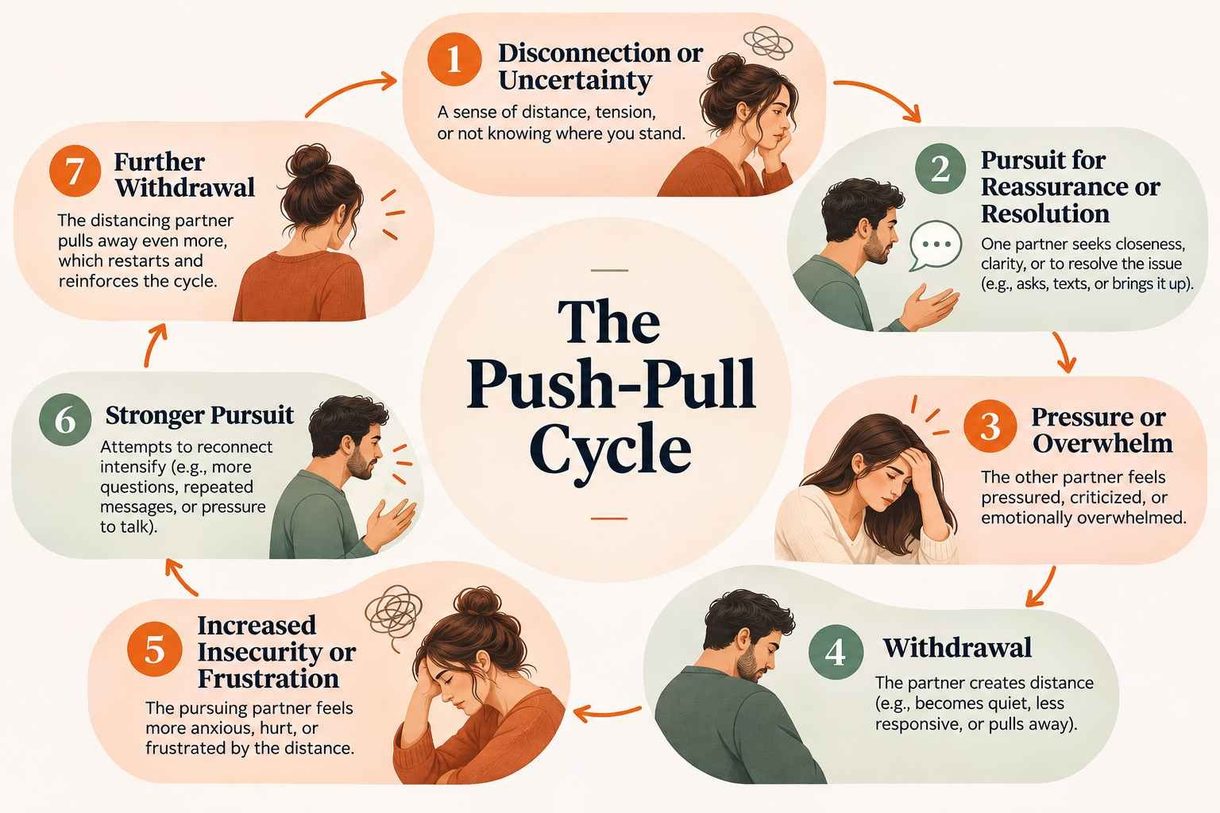
The surface topic may be texting, household responsibilities, sex, parenting, money, family boundaries, or time together. When the same sequence appears across different topics, couples can feel as though they are having the same argument repeatedly even when the subject changes.
What Does the Pursuing Partner Fear and Need?
The pursuing partner usually notices distance quickly and tries to reduce it. They may ask repeated questions, seek reassurance, bring up the same issue several times, send additional messages, or push for immediate resolution. The concern underneath may be fear of rejection, abandonment, not mattering enough, or being left alone with an unresolved problem. The need is often for responsiveness, clarity, reassurance, or evidence that the relationship is secure.
These reactions can overlap with anxious attachment or relationship anxiety, but being the pursuer in a particular conflict does not automatically mean someone has an anxious attachment style.
What Does the Withdrawing Partner Fear and Need?
The distancing partner may experience the same interaction as too intense or difficult to process. They may become quiet, give shorter answers, delay the conversation, leave, or focus on another task. Underneath the withdrawal may be fear of criticism, conflict, failure, losing autonomy, or making the situation worse. The need may be for lower emotional intensity, time to think, or confidence that they can participate without being overwhelmed.
Some of these behaviours can overlap with avoidant attachment in relationships, but a healthy request for space should not be confused with repeated avoidance or stonewalling.
What Causes a push pull relationship dynamic?
Attachment can influence how strongly partners respond to closeness, distance, disagreement, or uncertainty. Anxious strategies often involve restoring connection quickly, while avoidant strategies often involve reducing emotional intensity or relying more heavily on independence. When these strategies meet, more pursuit can create more withdrawal and more withdrawal can create more pursuit.
At the core is often attachment insecurity — the fear of being abandoned or overwhelmed. When closeness triggers anxiety, some people pull away to protect themselves. Others push for more closeness out of fear of losing the connection. Sometimes, one partner alternates between both roles.
The goal is not to eliminate independence or the desire for closeness, but to move toward a more secure attachment in which both partners can ask for connection, reassurance, or space directly.
Can the Pursuer and Distancer Roles Switch?
Yes. Pursuer and distancer are positions within an interaction, not permanent identities. A person who withdraws during emotional conversations may pursue around sex, money, parenting, or another issue, and roles can reverse when the usual pursuer eventually stops initiating contact. It is therefore more useful to ask what each person does when they feel insecure, pressured, criticized, or disconnected than to decide who “is” the pursuer or distancer.
Push–Pull Dynamics in Heterosexual Relationships
Gender socialization can influence how people learn to express vulnerability, ask for support, or respond to conflict, but it is too simplistic to assume that women pursue and men withdraw. In heterosexual relationships, either partner can occupy either role, and the role may change depending on the subject being discussed. Looking at the actual interaction is more useful than assigning the pattern based on gender.
Same-Sex and Queer Relationship Dynamics
Queer relationships aren’t immune to push and pull — but they often carry added layers:
- Internalized homophobia or shame can fuel fears of intimacy
- Navigating visibility and safety (especially in public or family spaces) can strain the connection
- Scarcity mindset in queer communities can lead people to hold on tightly — or run when it feels too intense
It’s important to recognize how these systemic and social forces shape emotional behaviour. Healing requires more than just individual effort — it requires context, compassion, and often community.
This is an important distinction when applying the pursuer–distancer framework. Minority stress, family rejection, discrimination, concerns about being out, or different levels of comfort with public visibility can add relationship pressure that is not explained by attachment style alone. A partner may seek reassurance or create distance partly in response to social and safety pressures outside the relationship, so effective support needs to consider both the couple’s interaction and the context around them.
Differentiation: Staying Connected Without Losing Yourself
A powerful concept in relational health is differentiation — the ability to stay emotionally connected to your partner while maintaining a solid sense of self.
Differentiation allows both partners to tolerate emotional discomfort without retreating or clinging. It’s what lets you say, “I’m upset, and I still love you,” or “I need space, and I’m not leaving.”
In practical terms, differentiation helps the pursuing partner tolerate some uncertainty without immediately escalating contact, while helping the distancing partner remain engaged without experiencing every request for closeness as a loss of autonomy. It supports a relationship in which connection and independence are not treated as opposites.
Push–Pull Dynamic vs. a Healthy Need for Space
Needing time alone does not automatically make someone the distancer, and wanting reassurance does not automatically make someone the pursuer. The difference is whether space is communicated, temporary, and followed by reconnection, or whether withdrawal repeatedly leaves the other partner uncertain and important issues unresolved.
| Healthy Need for Space | Push–Pull Pattern |
| Space is communicated clearly | Withdrawal happens with little explanation |
| Both partners know the conversation will continue | One partner is unsure whether the issue will be revisited |
| Time apart helps emotional regulation | Distance increases anxiety and further pursuit |
| Connection remains generally predictable | Closeness and distance fluctuate repeatedly |
| The partner returns as agreed | Important conversations are repeatedly avoided |
When withdrawal becomes a consistent response to conflict, see our guide to stonewalling in relationships for more specific strategies.
How can couples stop the pursuer–distancer cycle?
Emotionally Focused Therapy (EFT) focuses on identifying the negative interaction cycle and the emotions and attachment needs underneath it. Instead of deciding which partner is the problem, the couple learns to notice how each protective response triggers the next one. The following eight steps apply that approach to a push and pull pattern.
1. Name the cycle without blaming the person. Instead of “You’re ignoring me again,” try, “I think we’re getting into the pattern where I push for an answer and you pull away.”
2. Identify your automatic response. Notice whether disconnection makes you question, criticize, demand reassurance, shut down, leave, delay, or avoid responding.
3. Identify the need underneath the reaction. Anger may include fear of being unimportant; criticism may include loneliness; withdrawal may include fear of failure or escalation.
4. Replace pursuit with a clear request. Instead of “Why do you always shut me out?” try, “I’m worried that we’re disconnected. When can we talk about this?”
5. Replace unexplained withdrawal with communicated space. Say what you need and when you can return: “I need time to think. I’m not avoiding this. Can we talk again at 7:00?”
6. Regulate before continuing. If either partner is too activated to listen, pause rather than continuing through texts, repeated questions, or escalating arguments.
7. Rebuild trust through predictability. Return when you said you would, keep agreements, communicate changes in plans, and make room for regular connection outside conflict.
8. Review and repair the cycle after it happens. Identify where it started, what each person noticed, and what either partner could try differently next time.
For more on the therapeutic model behind these steps, see Emotionally Focused Therapy (EFT) for couples. If the cycle escalates into a larger argument, our guide to repairing after an argument can help with the post-conflict stage.
Scripts for the Pursuing Partner
- “I can feel myself getting anxious because we haven’t resolved this. When would you be ready to talk?”
- “I need some reassurance that we’re okay even if we don’t solve this immediately.”
- “I’m tempted to keep pushing for an answer, so I’m going to give this some space. Can we check in tonight?”
- “What I need right now is to know that this conversation matters to you.”
Scripts for the Distancing Partner
- “I want to answer you, but I need some time to think first.”
- “I’m feeling pressured and I can tell I’m starting to withdraw. Can we slow this down?”
- “I need a break, but I’m not abandoning the conversation.”
- “Can we continue this at 8:00? I’ll be in a better position to listen then.”
Common Mistakes When Trying to Fix a push pull dynamic relationship
Common mistakes include using attachment labels as criticism, telling the pursuer to “stop being needy,” telling the distancer to talk immediately, debating who started the cycle, treating every request for space as rejection, or expecting one partner to change first. A more useful approach is for each person to change the part they control: the pursuer makes clearer requests and tolerates reasonable pauses, while the distancer communicates the need for space and reliably reconnects.
When Couples Therapy Helps With a Push and Pull Dynamic Relationship
Couples therapy may help when the cycle happens frequently, important conversations repeatedly fail, one partner feels chronically rejected while the other feels chronically pressured, or both partners understand the pattern but cannot interrupt it. Therapy can also be useful when attachment injuries, identity-related stress, trust problems, or longstanding communication patterns are contributing to the cycle.
At Ellis Nicolson + Associates, relationship therapists work with couples experiencing attachment-related conflict, repeated pursuit and withdrawal, emotional disconnection, and recurring communication problems. EFT can help couples identify the cycle, understand the needs underneath it, and practise more secure ways of responding. Learn more about couples therapy in Mississauga.
Frequently Asked Questions About Push–Pull Relationships
What is a push pull dynamic relationship?
A push pull dynamic relationship is a repeating pattern in which one partner responds to insecurity by seeking more closeness or resolution while the other responds to pressure by creating distance. The two responses can reinforce each other.
How can couples stop the pursuer–distancer cycle?
Both partners need to recognize the pattern and change their automatic response. The pursuer can make clearer requests and tolerate reasonable pauses; the distancer can communicate the need for space and reliably return to the conversation.
What is a push pull relationship dynamic?
A push pull relationship dynamic describes repeated movement between increased closeness and increased distance. In couples therapy, this is often understood as an interactional cycle rather than a problem located entirely in one partner.
Is a push and pull dynamic relationship always unhealthy?
No. Couples naturally differ in how much closeness, independence, and processing time they need. The pattern becomes a problem when it is rigid, repeatedly escalates conflict, or prevents important issues from being resolved.
How to stop toxic push and pull relationship patterns?
Start by identifying the cycle instead of focusing only on who is at fault. The pursuing partner may need to reduce repeated reassurance-seeking or pressure, while the withdrawing partner may need to communicate the need for space without disappearing or leaving issues unresolved. Clear requests, agreed timeouts, predictable follow-up, and better emotional regulation can reduce the intensity of the cycle. If the pattern includes manipulation, intimidation, threats, or deliberate withdrawal used to punish or control, the issue may go beyond a communication problem and should be taken more seriously.
Best ways to fix push and pull dynamic relationship?
The most effective approach is usually for both partners to change their part of the pattern. The pursuing partner can practise making one clear request instead of escalating contact, while the distancing partner can communicate when they need space and give a specific time for reconnecting. Couples can also work on identifying triggers, improving emotional regulation, discussing one issue at a time, and building more predictable connection outside conflict.
How to handle partner with push and pull behavior?
Try not to respond to withdrawal with increasing pressure or to renewed closeness with immediate demands for reassurance. Instead, describe the pattern directly and ask for more predictable communication. For example: “When we get close and then you suddenly pull away, I feel uncertain. If you need space, can you tell me what you need and when we can reconnect?” It is also important to decide what level of inconsistency you are willing to accept if the pattern does not improve.
Is my relationship unhealthy push and pull dynamic?
A push and pull pattern becomes concerning when it is frequent, difficult to interrupt, and leaves one or both partners feeling chronically anxious, rejected, pressured, or emotionally disconnected. Other warning signs include repeated breakups and reconciliations, important conversations being avoided, intense closeness followed by unexplained withdrawal, or the same conflict repeating without progress. Occasional differences in closeness or the need for space do not automatically mean the relationship is unhealthy.
How to set boundaries in push and pull relationship?
Boundaries should focus on what you need and what you will do rather than trying to control your partner. You might say: “I respect that you need space, but I need you to communicate that rather than disappear,” or “I’m willing to talk about this, but I’m not going to continue if we start insulting each other.” Boundaries are most useful when they are specific, realistic, and consistently followed.
How to make push and pull relationship stable?
Greater stability usually comes from making connection and distance more predictable. That can include regular check-ins, communicating the need for space before withdrawing, agreeing on when difficult conversations will resume, following through on commitments, and reducing repeated reassurance-seeking. The goal is not constant closeness, but a relationship in which both partners can trust that temporary distance does not mean abandonment and closeness does not mean losing autonomy.
Signs I should leave push and pull relationship?
Consider whether the relationship is causing ongoing emotional harm, whether both partners are willing to work on the pattern, and whether meaningful change is actually happening. More serious warning signs include coercion, threats, intimidation, deliberate emotional punishment, repeated boundary violations, physical aggression, or one partner consistently refusing any responsibility for the relationship dynamic. If you feel unsafe, the priority should be safety rather than improving communication.
How to communicate needs in push and pull dynamic?
State the need directly rather than expressing it through criticism, repeated questioning, withdrawal, or tests of the relationship. For example, instead of “You never care when I’m upset,” try “I need reassurance that we’re okay, even if we need a break from this conversation.” A distancing partner might say, “I need 30 minutes to calm down, but I want to come back to this tonight.” Clear requests make it easier for both partners to respond without guessing what the other person needs.
How does therapy help push and pull relationships?
Couples therapy can help partners identify the pursuer–distancer cycle, understand the emotions and attachment needs underneath each person’s reactions, and practise different responses before the pattern escalates. Approaches such as Emotionally Focused Therapy can be especially useful because they focus on the negative interaction cycle rather than treating one partner as the problem. Therapy can also help couples improve emotional regulation, communication, repair, and their ability to ask for closeness or space more directly.