





Every couple experiences conflict. The health of a relationship is not determined by whether partners disagree, but by how they communicate when disagreements happen.
Sometimes, a conversation that begins with a relatively small concern quickly turns into blame, defensiveness, sarcasm, or silence. Dr. John Gottman describes four particularly damaging communication patterns as the Four Horsemen of the Apocalypse: criticism, contempt, defensiveness, and stonewalling.
The name may sound dramatic, but recognizing these patterns is not a reason to assume your relationship is doomed. Most couples use them occasionally, especially when they feel hurt, anxious, misunderstood, or emotionally overwhelmed. The important step is learning how to identify the Four Horsemen in your relationship and replace them with healthier alternatives.
TL;DR: The Gottman Four Horsemen
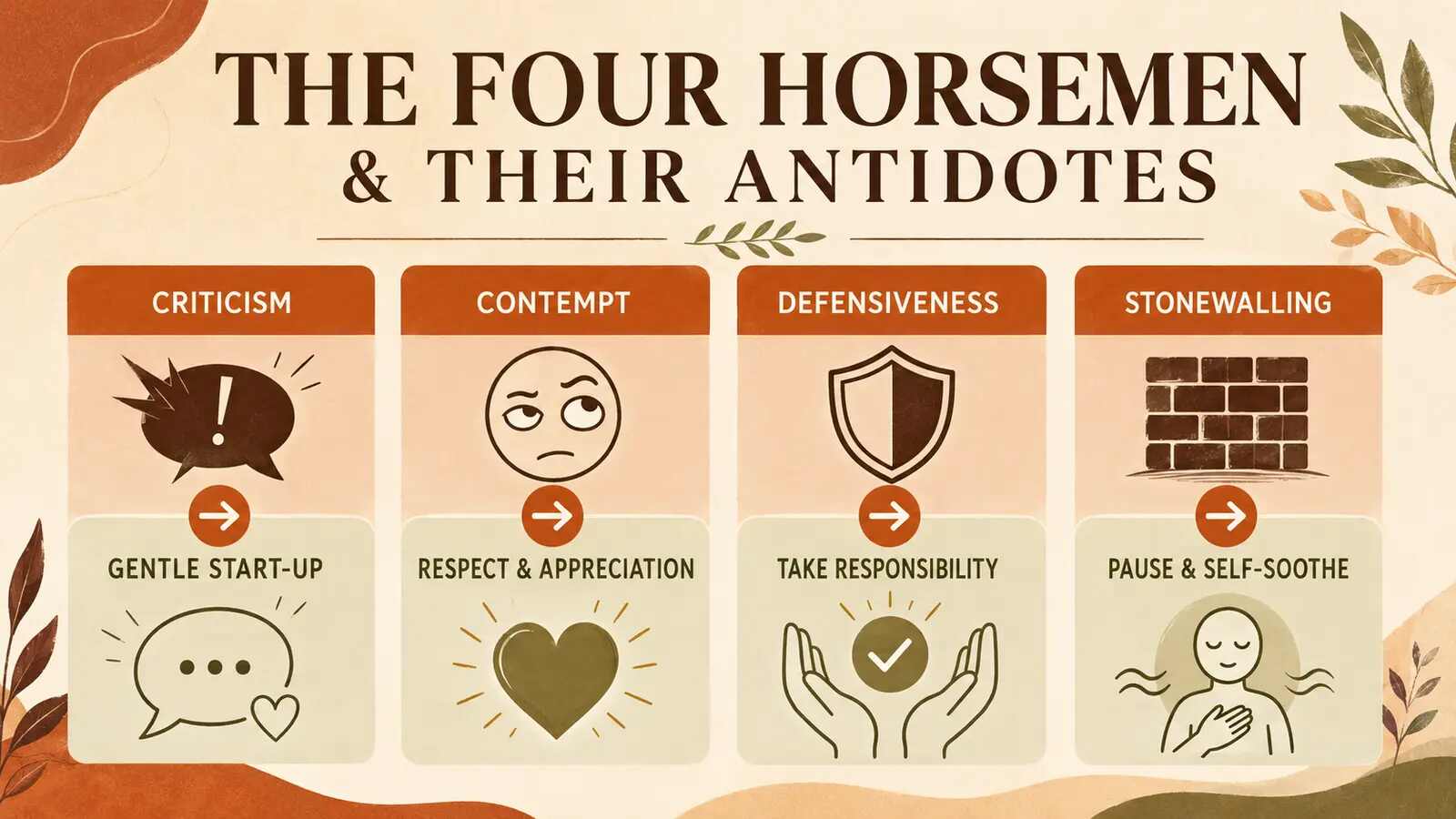
- The Gottman Four Horsemen are criticism, contempt, defensiveness, and stonewalling.
- These behaviours can escalate conflict and gradually weaken trust and emotional connection.
- Criticism attacks character; its antidote is a gentle start-up.
- Contempt communicates disrespect or superiority; its antidotes are expressing feelings and needs and building appreciation.
- Defensiveness avoids responsibility; its antidote is taking responsibility for at least part of the problem.
- Stonewalling involves emotionally or physically withdrawing; its antidote is physiological self-soothing followed by returning to the conversation.
- The goal is not to communicate perfectly. It is to notice destructive patterns sooner, repair them, and practise healthier responses.
- Couples therapy can help when these patterns feel entrenched or attempts to communicate differently repeatedly fail.
What Are the Four Horsemen in Relationships?
The Gottman Four Horsemen are four negative communication behaviours identified through Dr. John Gottman’s research with couples:
- Criticism
- Contempt
- Defensiveness
- Stonewalling
They are called the Four Horsemen because, when they become habitual, they can predict serious relationship distress. According to The Gottman Institute, identifying these behaviours during conflict is the first step toward replacing them with healthier, more productive communication.
The Four Horsemen are not labels for people. Your partner is not “a stonewaller,” and you are not “the critical one.” They are behaviours that often emerge as attempts to protect ourselves, express unmet needs, or manage emotional overwhelm.
Looking at them as part of a shared cycle can help couples move away from deciding who is the problem and toward understanding what happens between them.
The Gottman Four Horsemen and Their Antidotes
Each Horseman has a corresponding antidote, a healthier behaviour that communicates the underlying concern without increasing disconnection.
| Horseman | What it looks like | Antidote | Example phrase |
| Criticism | Attacking your partner’s character or personality | Use a gentle start-up and state your feelings and needs | “I feel overwhelmed when the kitchen is left like this. Could we clean it together after dinner?” |
| Contempt | Mocking, insulting, belittling, eye-rolling, or communicating superiority | Describe your feelings and needs; build a culture of appreciation | “I’m frustrated that we’re late. Being on time matters to me, and I’d like us to plan differently next time.” |
| Defensiveness | Making excuses, denying responsibility, counterattacking, or acting like the innocent victim | Accept responsibility for your part | “You’re right. I said I would call, and I forgot. I understand why that upset you.” |
| Stonewalling | Shutting down, turning away, refusing to respond, or leaving without explanation | Pause, self-soothe, and agree to return | “I’m too overwhelmed to listen properly. Can we take 20 minutes and continue at 7:30?” |
Horseman 1: Criticism
Criticism is more than expressing dissatisfaction. A complaint focuses on a specific behaviour or situation, while criticism attacks the other person’s character.
Complaint:
“I felt worried when you didn’t message me to say you would be late.”
Criticism:
“You never think about anyone but yourself.”
Words such as “always” and “never” frequently appear in criticism. The conversation shifts from what happened to what is supposedly wrong with the other person.
The antidote to criticism: A gentle start-up
A gentle start-up describes the situation without blame and explains what you feel and need.
A simple structure is:
“I feel ___ about ___, and I need ___.”
For example:
“I feel disconnected when we spend the whole evening on our phones. Could we put them away during dinner tonight?”
The gentle start-up is not about minimizing the issue or being agreeable at all costs. It allows you to communicate a legitimate concern without turning your partner into the target.

Horseman 2: Contempt
Contempt communicates disgust, disrespect, mockery, or moral superiority. It may appear through:
- Sarcasm or hostile humour
- Insults and name-calling
- Eye-rolling or sneering
- Mimicking your partner
- Talking down to them
- Suggesting that you are smarter, more responsible, or more emotionally mature
An example might be:
“Of course you forgot. I don’t know why I expect you to handle anything.”
Contempt is particularly damaging because it communicates that your partner is beneath you rather than simply mistaken. Gottman identifies contempt as the most destructive of the Four Horsemen.
The antidote to contempt: Respect and appreciation
In the moment, replace contempt with a direct description of your feelings and needs:
“I feel stressed when important tasks are forgotten. I need us to find a system we can both follow.”
Over time, couples can reduce contempt by building a culture of fondness and admiration. This involves regularly noticing and expressing what you respect, value, or appreciate about each other.
Appreciation does not mean ignoring real problems. It helps prevent frustration from becoming a negative story in which everything your partner does is interpreted as proof of their inadequacy.
Horseman 3: Defensiveness
Defensiveness is a common response to feeling blamed, criticized, or misunderstood. It can involve excuses, counterattacks, denial, or shifting responsibility back to the other person.
For example:
“I didn’t call because you kept distracting me this morning. You could have done it yourself.”
Defensiveness may feel like self-protection, but it often tells your partner that their concern does not matter or that the problem is entirely their fault.
The antidote to defensiveness: Take responsibility
You do not have to accept all the blame or agree with every detail. Look for the part of the concern that is valid and take responsibility for your contribution.
“You’re right that I said I would call. I forgot, and I should have told you sooner.”
Taking responsibility does not make you weak or automatically make your partner right. It shows that protecting the relationship is more important than winning every point.
Horseman 4: Stonewalling
Stonewalling occurs when someone withdraws from the interaction. They may stop responding, avoid eye contact, turn away, become unusually quiet, leave the room, or behave as though they cannot hear their partner.
Stonewalling can appear uncaring from the outside. However, it often happens when someone is emotionally flooded, their physical and emotional arousal has become so intense that continuing the conversation feels impossible.
Stonewalling differs from a healthy break. A healthy break is explained, time-limited, and followed by a return to the discussion. Stonewalling leaves the other partner uncertain about whether communication will resume.
The antidote to stonewalling: Self-soothing
Tell your partner that you are overwhelmed and need time to regulate:
“I care about resolving this, but I’m too overwhelmed to continue constructively. I need 30 minutes, and then I’ll come back.”
During the break, do something genuinely calming: walk, breathe slowly, listen to music, stretch, or focus on your surroundings. Avoid rehearsing arguments or building a case against your partner.
How the Four Horsemen Escalate Conflict
The Gottman Four Horsemen often appear as an interconnected escalation pattern rather than four isolated behaviours.
For example, one partner may say:
“You never make time for me. You only care about work.”
The other becomes defensive:
“That’s ridiculous. I work this much because you keep spending money.”
The first partner responds with contempt:
“Right, because you’re the only responsible adult here.”
The second partner becomes overwhelmed, stops responding, and leaves. The first experiences that withdrawal as further proof that their partner does not care and pursues the conversation more intensely.
This can become a familiar push–pull pattern: the more one partner protests or pursues, the more the other withdraws; the more the other withdraws, the more urgently the first partner pursues.
Neither person may intend to create disconnection. Both may be trying to protect themselves or restore security in different ways.
What to Do When the Four Horsemen Appear
Use this step-by-step communication guide when you recognize one of the Four Horsemen during an argument.
1. Name the pattern without labeling your partner
Say:
“I think we’ve moved into criticism and defensiveness.”
Avoid:
“You’re being one of the Four Horsemen again.”
The goal is to identify the shared pattern, not turn the framework into another weapon.
2. Pause the escalation
Stop trying to solve the original issue while one or both partners are emotionally overwhelmed. Continuing usually creates additional injuries that will also require repair.
3. Regulate your body
Slow your breathing, relax your hands and shoulders, put your feet on the floor, or take a structured break. If you pause the conversation, agree on a specific time to return.
4. Identify the underlying feeling and need
Ask yourself:
- What am I feeling beneath my anger?
- What am I afraid this situation means?
- What do I need my partner to understand?
- What specific request could I make?
Criticism often conceals loneliness or an unmet need. Defensiveness may conceal shame. Contempt can grow from accumulated resentment, while stonewalling may reflect emotional flooding.
5. Use the appropriate antidote
Replace criticism with a gentle start-up, contempt with respect, defensiveness with responsibility, or stonewalling with self-soothing and a planned return.
6. Make and receive a repair attempt
A repair attempt is any statement or action intended to stop negativity from escalating. It only works if one partner offers it and the other is willing to notice or accept it.
7. Return to the original issue
Once both partners are calmer, discuss one issue at a time. Describe specific behaviours, listen for the need beneath the complaint, and work toward a realistic agreement.
10 Repair Phrases Couples Can Use
Repair phrases may feel unnatural at first, particularly if you are accustomed to arguing until one person withdraws or gives in. Choose language that sounds authentic to you.
- “Can we start this conversation again?”
- “I said that too harshly. Let me try again.”
- “You’re right about that part.”
- “I can see why that hurt you.”
- “I’m becoming defensive, but I want to understand.”
- “We’re on the same team, even though we disagree.”
- “What do you need me to understand right now?”
- “I’m feeling overwhelmed. Can we take a short break and come back?”
- “I’m sorry for how I spoke to you.”
- “I care more about us than about winning this argument.”
The Gottman Institute describes repair attempts as statements or actions that prevent negativity from escalating. Couples do not need to avoid every mistake; they need ways to recognize disconnection and return to each other.
How Can Couples Heal After Using the Four Horsemen?
Replacing the Four Horsemen requires more than memorizing better sentences. Couples also need to address the hurt, fear, resentment, or emotional disconnection underneath them.
A helpful repair conversation may include:
- Acknowledging exactly what happened
- Taking responsibility without adding excuses
- Listening to how your behaviour affected your partner
- Offering a sincere apology
- Clarifying what each person needed
- Agreeing on what to do differently next time
- Following through consistently
Emotional repair becomes easier when couples strengthen their everyday connection. Affection, appreciation, curiosity, shared time, and responding to small bids for attention all create a stronger foundation for difficult conversations.
For more guidance, explore our article on how to build emotional connection in a relationship.
How Gottman Method and EFT Work Together?
The Gottman Method and Emotionally Focused Therapy (EFT) offer complementary ways of understanding couple conflict.
Gottman-based work provides practical tools for identifying damaging communication behaviours and replacing them with healthier alternatives. It helps couples see what they are doing during conflict and offers clear skills for responding differently.
EFT explores the deeper emotional and attachment needs organizing the conflict. It asks what the pattern means emotionally and what each partner is protecting beneath criticism, anger, defensiveness, or withdrawal.
For example, criticism may contain the underlying message:
“I’m afraid I don’t matter to you, and I need reassurance that you are here.”
Stonewalling may contain:
“I’m afraid I will fail or make this worse, so I shut down to protect myself and our relationship.”
EFT helps partners access and share these more vulnerable emotions, while Gottman tools help them communicate those emotions more safely. Together, the approaches can help couples interrupt destructive cycles and create greater security and emotional connection. EFT is grounded in attachment science and emphasizes emotion and emotional regulation in relationship interactions.
When to Seek Couples Therapy?
Consider couples therapy when:
- The Four Horsemen appear in most disagreements
- Arguments repeatedly escalate without resolution
- Contempt or resentment has become common
- One partner pursues while the other consistently withdraws
- Conversations leave either partner feeling afraid, hopeless, or emotionally unsafe
- Repair attempts are ignored or rejected
- The same conflict returns despite repeated promises to change
- Anxiety, trauma, betrayal, or attachment injuries are intensifying the pattern
- You feel more like opponents than partners
You do not need to wait until your relationship reaches a crisis. Therapy can help you recognize the cycle, understand the emotions underneath it, and practise new responses with support.
At Ellis Nicolson + Associates, our relationship therapists use evidence-informed approaches, including Gottman-based strategies and EFT, to help couples reduce destructive conflict and rebuild connection. If anxiety is contributing to rumination, reassurance-seeking, or heightened reactivity, learn more about our axinety therapy services.
Frequently Asked Questions
Gottman Four Horsemen signs in romantic relationships
Common signs include personal criticism, sarcasm, mockery, eye-rolling, blame-shifting, excuses, emotional withdrawal, and refusing to engage during conflict. These behaviours may appear occasionally in many relationships, but they become concerning when they form a repeated communication pattern.
How to apply Gottman Four Horsemen in marriage?
Couples can apply the framework by noticing when criticism, contempt, defensiveness, or stonewalling appears during disagreements. They can then replace each behaviour with its corresponding antidote: a gentle start-up, respect and appreciation, taking responsibility, or taking a structured break to self-soothe.
What are Gottman Four Horsemen in relationships?
The Gottman Four Horsemen are criticism, contempt, defensiveness, and stonewalling. Dr. John Gottman identified these communication behaviours as patterns that can escalate conflict and weaken trust, respect, and emotional connection when they become habitual.
How to stop Gottman Four Horsemen communication patterns?
Start by naming the shared pattern without labeling or blaming your partner. Pause the escalation, regulate your emotions, identify the underlying feeling or need, and use the appropriate antidote. Consistent repair and repeated practice are usually more effective than expecting immediate perfection.
Gottman Four Horsemen conflict patterns explained for couples
The pattern often begins with criticism, which triggers defensiveness. When neither partner feels heard, the conflict may escalate into contempt. Eventually, one partner may become emotionally flooded and stonewall, which can make the other pursue the conversation more intensely.
How to avoid Gottman Four Horsemen during arguments?
Begin difficult conversations gently, focus on a specific situation, and explain what you feel and need without attacking your partner’s character. Take responsibility for your part, avoid sarcasm or disrespect, and pause the conversation if either person becomes too overwhelmed to listen constructively.
How to replace the Gottman Four Horsemen behaviors?
Replace criticism with a gentle start-up, contempt with respect and appreciation, defensiveness with taking responsibility, and stonewalling with physiological self-soothing followed by a planned return to the conversation. These antidotes allow couples to address real concerns without intensifying disconnection.
Gottman Four Horsemen step by step communication guide
First, identify which Horseman has appeared. Next, pause and regulate your emotional response. Identify the vulnerable feeling or unmet need beneath your reaction, choose the corresponding antidote, and make a repair attempt. Once both partners feel calmer, return to the original issue and discuss one specific concern at a time.
How can couples heal after Gottman Four Horsemen?
Couples can heal by acknowledging what happened, taking responsibility, listening to how each person was affected, and offering a sincere repair. Rebuilding emotional connection also requires consistent appreciation, affection, curiosity, and follow-through—not only better communication during arguments.
Gottman Four Horsemen antidotes for healthier communication
The four antidotes are using a gentle start-up instead of criticism, building respect and appreciation instead of contempt, taking responsibility instead of becoming defensive, and practising self-soothing instead of stonewalling. Together, these skills help couples manage conflict more safely and constructively.