






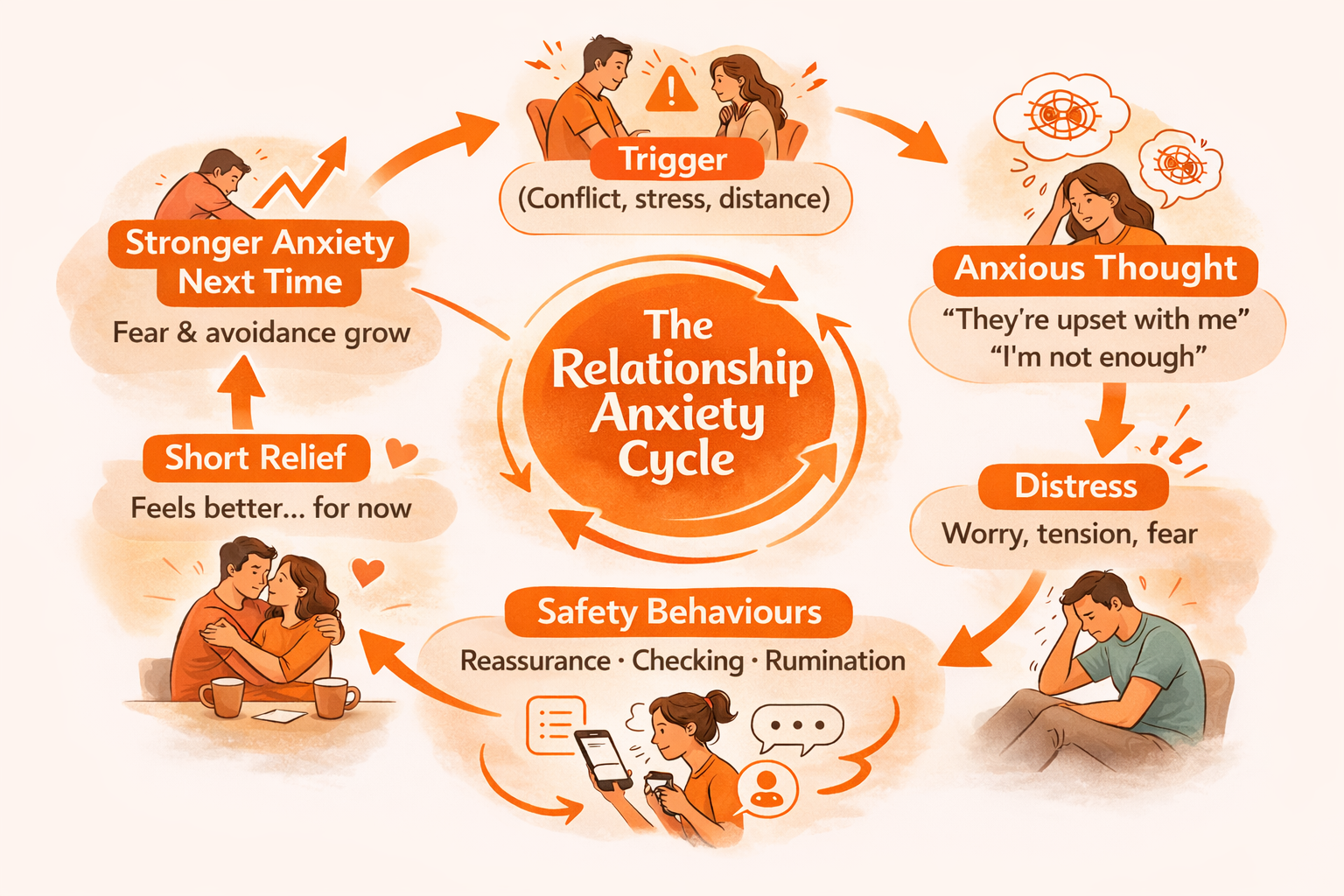
TL;DR Relationship anxiety is a pattern of worry, doubt, and “what if” thinking about your relationship (or your partner’s feelings) that keeps pulling you out of connection and into checking, reassurance-seeking, or emotional shutdown. It can show up in new relationships, long-distance relationships, or long-term partnerships, especially during transitions (moving in, engagement, postpartum, job stress). The goal isn’t to “prove” the relationship is perfect; it’s to calm the anxiety system, stop the compulsive loops, and build secure connection. This post covers a signs checklist, an “anxiety vs intuition” table, a 9-step CBT plan (rumination + reassurance limits + behavioural experiments), an EFT lens (“the cycle is the enemy”), scripts to talk to your partner, mistakes to avoid, FAQs, when to seek help, and how therapy (CBT/EFT/EMDR) can support you.
Read our blog and learn about relationship anxiety , what it is, as well as the signs, and possible causes. Plus, how to deal with relationship anxiety if you’re feeling uneasy.
What is relationship anxiety?
Relationship anxiety is persistent, distressing worry about the relationship, your partner’s feelings, your own feelings, or the future, often paired with urges to check, test, scan for threats, seek reassurance, or “solve” uncertainty.
Relationship anxiety can feel like:
- “Why do I feel uneasy in my relationship?”
- “Do I have relationship anxiety, or am I ignoring a red flag?”
- “Can anxiety ruin relationships?” / “Does anxiety ruin relationships?”
- “Why do I have so much anxiety in my relationship when nothing is ‘wrong’?”
Additionally, psychotherapists are often faced with questions like: Can a relationship cause anxiety? Or can a bad relationship cause anxiety? It’s important to know that both can be true. Sometimes anxiety is driven by attachment wounds, past betrayals, or OCD-like doubt loops. Other times, your nervous system is responding to real instability, like dishonesty, inconsistency, or emotional unavailability. The work is learning to tell the difference and respond in a way that actually helps.
In CBT terms, it’s anxiety maintained by a cycle:
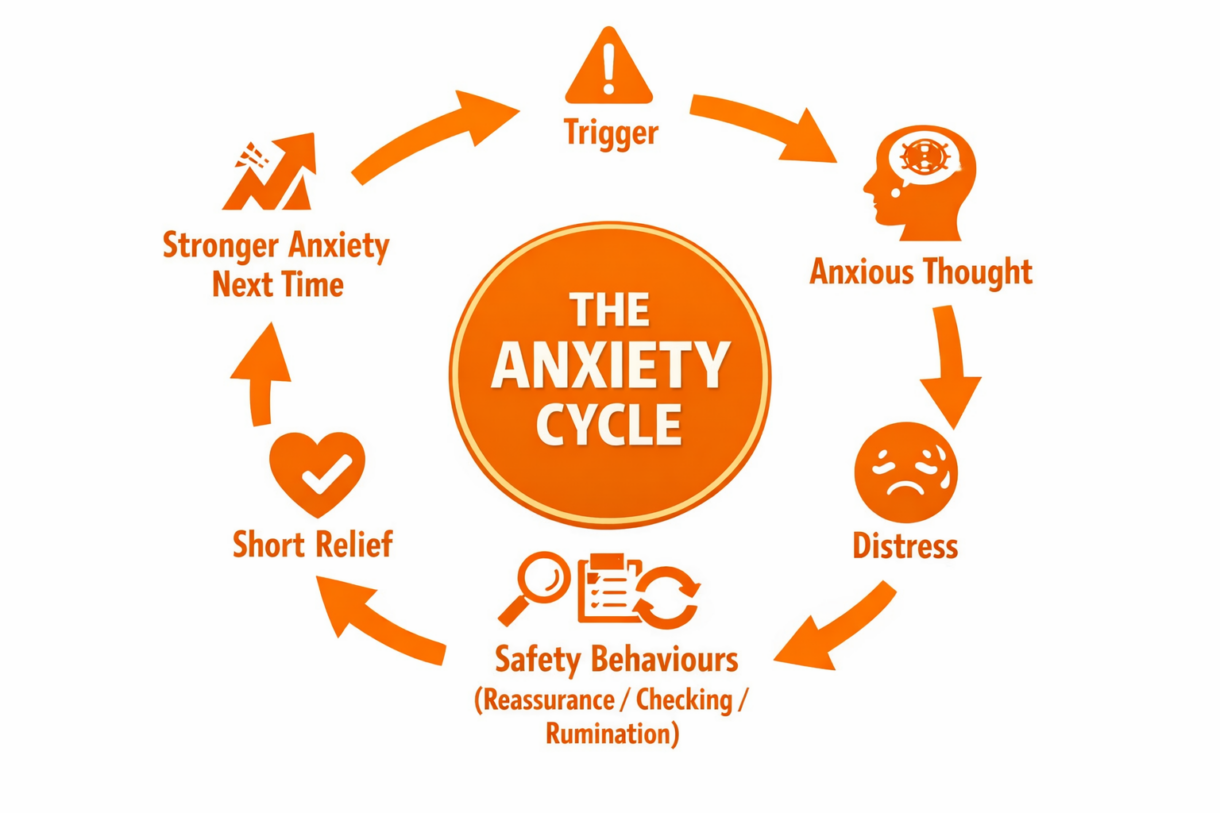
The Anxiety Cycle graph
In attachment terms, it’s often a protest signal: “Connection feels uncertain, so I’m going to hyper-focus to regain safety.”
Relationship anxiety can happen:
- at the beginning of a relationship (new relationship anxiety)
- after conflict, distance, illness, job stress, fertility challenges
- after past betrayal/trauma
- in long distance relationships
- alongside generalized anxiety, panic, depression, or relationship OCD patterns
10 common signs of relationship anxiety
Relationship anxiety doesn’t look the same for everyone. Here are 10 common patterns we see in our practice, you can use them as reference points to better understand what’s happening.
#1 Doubting the other person’s feelings
This goes beyond occasional uncertainty. You might feel a steady need to confirm your partner’s affection, loyalty, or commitment, even when their behaviour is generally caring. Small shifts (a quieter mood, a shorter reply, a busy day) can trigger a fear story like “They’re losing interest.” You may replay recent moments to find “evidence,” or compare today’s connection to an earlier honeymoon stage and worry you’re fading.
#2 Needing or seeking frequent reassurance
You ask questions like “Are we okay?” “Do you still love me?” or “Are you mad at me?” more often than you’d like, sometimes multiple times in the same situation. The tricky part is that reassurance can work briefly, then anxiety returns and asks for another “hit.” Over time, reassurance becomes less soothing and more like a compulsion, leaving you dependent on certainty you can’t fully get.
#3 People-pleasing
People-pleasing in relationship anxiety often looks like over-functioning: you do more, give more, accommodate more, and smooth everything over so your partner won’t be disappointed or upset. You may become the “easy” partner who never complains, until you’re exhausted or resentful. Underneath is often the belief: “If I’m perfect and low-maintenance, they won’t leave.”
#4 Self-silencing
Self-silencing is a close cousin of people-pleasing, but more internal. You minimize your needs, shrink your emotions, or avoid expressing boundaries because you fear conflict will threaten the relationship. You might tell yourself “It’s not a big deal” when it is, or postpone hard conversations until you’re flooded. Self-silencing can keep the peace short-term, but it tends to increase anxiety and distance long-term.
#5 Looking for problems
Your mind becomes a detective. You scan for signs of incompatibility, hidden meanings, or “dealbreakers,” and you may compulsively research: “How do I know if I’m with the right person?” “Is this a red flag?” Even positive moments can be followed by mental checking: “But what about long-term?” The more you look for certainty, the more doubts appear, because no relationship offers perfect proof.
#6 Worrying more than enjoying the relationship
You might notice that you can’t fully relax into dates, intimacy, or connection. Part of you is there; part of you is monitoring. Instead of enjoying closeness, you’re evaluating it: “Did that feel loving enough?” “Why didn’t they text sooner?” “Was that joke a sign?” Over time, anxiety steals the “good data” of the relationship because you’re busy scanning for danger.
#7 Fear of abandonment (or intense distress during separation)
Fear of abandonment can show up as panic when plans change, when your partner is less available, or when you’re apart. You may feel a spike of dread during separations, travel, or long-distance periods, and your mind fills the gaps with worst-case scenarios. Some people experience this as separation anxiety in a relationship, a distress that feels bigger than the actual separation.
#8 Overanalyzing and mind-reading
You interpret small cues, tone, punctuation, emojis, pauses, as signals of hidden meaning. A delayed reply becomes “They’re ignoring me.” A quiet evening becomes “They’re bored.” Mind-reading feels like protection, but it increases anxiety because you’re responding to assumptions rather than reality. It also puts pressure on your partner to constantly manage how they come across.
#9 Checking behaviours (including digital checking)
Checking can be obvious (asking repeated questions) or subtle (re-reading texts, checking “last seen,” scrolling socials, comparing yourself to others, monitoring who liked what). The intention is to reduce anxiety. The effect is often the opposite: checking trains your brain to believe the threat is real, because “If I have to check, it must be dangerous.”
#10 Conflict sensitivity, testing, or sabotage
Some people avoid conflict entirely; others escalate quickly to get certainty. You might “test” your partner by pulling away to see if they chase, picking fights to see how committed they are, or bringing up breakups to relieve the uncertainty temporarily. Sabotage can also look like emotional shutdown: “If I detach first, it won’t hurt as much.” These strategies make sense as protection, but they often create the exact distance you fear.
How to spot the signs of relationship anxiety (Signs checklist)
Use this checklist as a gentle self-assessment (not a diagnosis). If you’re wondering “how do I know if I have relationship anxiety,” start here:
1. Doubting the other person’s feelings
- You replay texts/tones for “proof” they’re pulling away
- You assume silence = rejection
- You fixate on whether they love you “enough”
2. Needing or seeking frequent reassurance (excessive reassurance-seeking)
- Asking “Are we okay?” repeatedly
- Checking if they’re upset even after they say no
- Feeling brief relief, then the doubt returns
3. People-pleasing (self-silencing)
- You avoid bringing up needs to prevent conflict
- You over-function, over-apologize, or perform
- You fear being “too much” and swallow resentment
4. Looking for problems
- Scanning for signs you’re incompatible
- Googling “signs we should break up”
- Testing your partner (withdrawing to see if they chase)
5. Worrying more than enjoying the relationship
- “I can’t relax unless I’m sure”
- Difficulty being present during dates/sex
- You miss out on the good times because you’re analyzing
6. Fear of abandonment
- Panic when plans change
- Intense distress during separations/trips
- Fantasizing about being left, betrayed, or replaced
Related patterns you might notice:
- Reading into their words and actions
- Wondering if you matter to your partner
- Worrying they want to break up
- Doubting long-term compatibility
- Sabotaging the relationship / signs of sabotage
“Why do I feel uneasy in my relationship?”
Sometimes uneasiness is about the relationship. Sometimes it’s about the alarm system. Anxiety narrows attention toward threat, so the mind starts collecting “evidence” that something is wrong: a shorter text, a distracted tone, a missed plan. When you’re anxious, ambiguity feels intolerable, so you try to fix it with checking, asking, analyzing, or controlling.
A helpful question is: Is my uneasiness pointing to a consistent pattern (dishonesty, disrespect, emotional unavailability, instability), or is it an anxiety-driven alarm demanding certainty? Both deserve care, but they call for different responses.
Is it relationship anxiety or intuition?
When you’re anxious, your brain is trying to protect you, so it scans for danger and pushes you to get certainty right now. That urgency can make normal relationship ambiguity (a slower text, a distracted tone, a missed plan) feel like proof something is wrong. Intuition, on the other hand, usually isn’t loud or panicky, it tends to be steady, specific, and grounded in repeated patterns over time. If you’re stuck asking: “Is it relationship anxiety or intuition?” the goal isn’t to dismiss your feelings; it’s to check whether you’re responding to a real, consistent signal, or to an anxiety-driven alarm that’s demanding reassurance. Use the table below as a quick reality-check.
| Question | More like anxiety | More like intuition |
| Speed/Intensity | Fast spike, urgent, catastrophic | Steady, calm, clear “knowing” |
| Evidence | Vague, “what if,” mind-reading | Specific patterns + facts over time |
| Body cues | Agitated, tight chest, spiralling | Grounded, firm boundary energy |
| Behaviour urge | Check, accuse, test, reassure, stalk socials | Clarify, set limits, address one issue |
| After action | Relief is short; doubt returns | Relief increases; clarity holds |
| Focus | Certainty-seeking | Values + safety-seeking |
“Anxiety vs intuition” mini-table
If you’re stuck in “is it relationship anxiety or intuition” loop, a therapist can help you sort signal vs noise using behavioural experiments, values work, and relationship patterns over time. Book a free consultation today!
What causes relationship anxiety?
Relationship anxiety usually isn’t random. It’s often the result of your brain doing what it learned to do to keep you safe.
Previous relationship experiences: Past betrayal, cheating, sudden breakups, or inconsistent partners can teach your nervous system: “Don’t relax, stay ready.” Even if your current partner is kind, old learning can get reactivated by familiar cues (distance, conflict, uncertainty).
Low self-esteem: If a part of you believes you’re “too much” or “not enough,” you may scan for signs you’re being rejected. The relationship becomes a mirror for self-worth, so any wobble feels like a verdict.
Attachment style: People with anxious attachment often experience closeness as precious and fragile, so distance feels like loss. People with avoidant attachment may feel overwhelmed by needs and pull away, which can amplify the anxious partner’s alarm. (This is a pattern, not a flaw.)
A tendency to question: Some people are naturally sensitive to uncertainty or prone to overthinking. In relationships, that can become constant “rightness” checking: “What if I’m with the wrong person?” The more you try to think your way to certainty, the louder doubt becomes.
How to manage anxiety in a relationship (A 9-step CBT plan)
If you’ve been looking up ways to manage relationship anxiety, the steps below give you a simple weekly plan to follow.
Step 1: Name the loop (externalize it)
Instead of “I’m needy/crazy,” try: “My anxiety loop is activated.”
Labeling reduces shame and creates distance from thoughts.
Step 2: Track triggers and themes
Common triggers: delayed replies, tone changes, social media, conflict, sex, future talk, travel, meeting friends/family.
Common themes: abandonment, not enough, betrayal, incompatibility, being trapped.
Write: Trigger → Thought → Feeling → Urge → What I did → Result (short-term/long-term).
Step 3: Treat rumination like a compulsion (rumination plan)
Rumination feels like “problem-solving,” but it often functions like checking.
Try a 2-part rule:
- Contain it: “I will not analyze this outside my scheduled worry window.”
- Replace it: shift to a grounding action (walk, shower, breath, values task).
A simple script: “Thanks mind. Not now. I’m practicing trust/uncertainty tolerance.”
Step 4: Set reassurance limits (reassurance diet)
Reassurance can become the gasoline. Create clear limits with compassion:
- Max 1 reassurance ask per day (or per trigger)
- No repeating the same question
- Ask for connection, not certainty (“Can we cuddle for 10 minutes?” vs “Do you still love me?”)
This helps you learn how to handle relationship anxiety without relying on constant proof.
Step 5: Identify thinking traps
Common CBT traps in relationship anxiety:
- Mind-reading: “They’re bored of me.”
- Fortune-telling: “This won’t last.”
- Catastrophizing: “If we fight, it’s over.”
- Emotional reasoning: “I feel anxious, so something is wrong.”
- All-or-nothing: “If it’s not effortless, it’s not right.”
Step 6: Build a balanced thought (not a “positive” one)
Balanced thoughts sound like reality, not hype:
- “I don’t have full certainty, and I can handle uncertainty.”
- “A slower reply could mean they’re busy; I’ll check in later.”
- “Conflict is information, not doom.”
Step 7: Behavioural experiments (the fastest way to learn)
Instead of debating thoughts, test them kindly. Examples:
- Delay checking: wait 30 minutes before re-reading texts. Track anxiety rise/fall.
- One-message rule: send one clear message, then stop.
- Ask directly once: practice concise vulnerability, then tolerate uncertainty.
- Do the opposite of the urge: if you want to interrogate, try a bid for closeness.
Record: prediction → experiment → outcome → what I learned.
Step 8: Strengthen secure behaviours (identity + wellbeing)
Relationship anxiety decreases when your life has sturdier pillars: sleep, movement, friendships, hobbies, meaning. This isn’t “be independent so you don’t need anyone.” It’s nervous system stability.
Step 9: Create a repair routine after triggers
A 10-minute routine:
- regulate body (breathing, grounding)
- name the story (“abandonment alarm”)
- choose one effective action (connection request OR self-soothing)
- return to values (how you want to show up)
Over time, this is how to overcome relationship anxiety in a way that lasts.
How to handle relationship anxiety (EFT lens: “the cycle is the enemy”)
In Emotionally Focused Therapy (EFT), we often say “the cycle is the enemy, not each other.” Relationship anxiety isn’t just inside one person, it often becomes a dance:
- Anxious partner: pursues, questions, seeks reassurance, protests distance
- Other partner: withdraws, shuts down, gets defensive, avoids conflict
- Result: more anxiety, more withdrawal, less safety for both
EFT helps couples identify the cycle, name the underlying attachment needs (reassurance, closeness, feeling chosen), and create new moments of safe emotional connection. The goal isn’t perfect calm; it’s secure responsiveness: “When you’re scared, I can find you, and when I’m overwhelmed, I can come back.”
8 scripts for talking to a partner about relationship anxiety
If you’re wondering should I tell my partner about my relationship anxiety, often yes, if it’s done with ownership and a plan. Here are scripts you can copy/paste:
- Simple ownership
“Sometimes my anxiety gets loud and I start overthinking. I’m working on it, and I’d love your support without us getting stuck in reassurance loops.” - Request for connection (not certainty)
“I’m feeling wobbly today. Could we do 10 minutes of closeness, cuddle or a check-in, so my nervous system settles?” - Boundary around reassurance
“I’m trying a reassurance limit so I don’t feed the anxiety. If I ask the same question again, can you gently remind me of our plan?” - Clarifying a trigger
“When plans change last-minute, I get a fear spike. It helps if you tell me what’s happening and when we’ll reconnect.” - Repair after conflict
“I’m still activated from our argument. Can we do a quick repair: what each of us heard, what we needed, and one thing we can try next time?” - Long-distance relationship anxiety
“When we’re apart, my mind fills gaps with worst-case stories. Can we agree on a predictable call schedule and a ‘goodnight’ message?” - Reducing partner accommodation
“I don’t want you to feel like you have to manage my anxiety. If I’m spiralling, it helps most when you stay kind but don’t debate the fear.” - Vulnerability (EFT-style)
“Under the questions, I’m scared of not mattering. I don’t want to accuse you, I want to feel close and safe with you.”
These also help if you’re searching how to explain relationship anxiety to your partner or how to talk to your partner about relationship anxiety.
Common mistakes that keep relationship anxiety stuck
- Trying to think your way to certainty (more analysis = more doubt)
- Using reassurance as the main coping strategy
- Testing your partner (withdrawing, passive aggression, “prove it”)
- Ignoring your body (sleep deprivation and stress amplify anxiety)
- Making anxiety a morality issue (“I’m too needy” / “They should fix me”)
- Avoiding direct conversations until you explode
- Confusing intensity with truth (anxiety feels urgent, but urgency isn’t accuracy)
Anxiety in relationships FAQs
Yes. Most people feel it during change or vulnerability. It becomes a problem when it’s persistent and drives compulsive behaviours or constant distress.
Yes. Anxiety can be triggered by uncertainty, attachment history, or real instability. A therapist can help distinguish internal anxiety patterns from external red flags.
Yes. Chronic criticism, gaslighting, inconsistency, infidelity, or emotional neglect can activate anxiety and hypervigilance.
Anxiety itself doesn’t “ruin” relationships, unmanaged cycles can. When partners learn skills (CBT/EFT), relationships often become stronger.
It can increase conflict, reduce intimacy, create misunderstandings, and lead to pursuit–withdraw cycles. It can also reduce joy and presence.
Treat overthinking as rumination: label it, contain it, redirect attention, and use behavioural experiments instead of debates.
It varies. For many, early spikes settle as safety and routines build. If it lasts months, escalates, or interferes with functioning, support can help.
Often yes, especially with skills, deeper attachment work, and (when relevant) trauma processing. The aim is not “never anxious,” but recovering faster with less compulsion.
When to seek help?
Consider anxiety, or even couples therapy if:
- You frequently ask “why do I have relationship anxiety” and it’s not improving
- You’re stuck in reassurance-seeking, checking, or rumination
- Anxiety is impacting sleep, work, appetite, intimacy, or mood
- You’re experiencing panic, intrusive thoughts, or trauma triggers
- Your relationship is stuck in the same fight/withdraw pattern
- You suspect past trauma, betrayal, or attachment wounds are driving the intensity
If there is coercion, threats, stalking, or violence, seek immediate safety supports.
How therapy helps (EFT/CBT/EMDR)
A psychotherapy approach can be tailored depending on what’s maintaining the anxiety:
- CBT (Cognitive Behavioural Therapy): helps you reduce rumination, challenge thinking traps, set reassurance limits, and run behavioural experiments that build tolerance for uncertainty. This is especially helpful if you are interested in how to control relationship anxiety and its patterns.
- EFT (Emotionally Focused Therapy): helps couples (or individuals) understand attachment needs, soften reactivity, and change the pursuit–withdraw cycle. You learn to create secure bids, repairs, and emotional safety.
- EMDR (Eye Movement Desensitization and Reprocessing): can help when relationship anxiety is fueled by past trauma (betrayal, abandonment, unpredictable caregiving, prior toxic relationships). It targets the nervous system “alarm” so present-day triggers don’t feel like old dangers.
Calm your mind, Change your life – Book a Free Consultation
If relationship anxiety is making you feel stuck, whether you’re in Mississauga, Toronto, or nearby, we can help you build calm, clarity, and secure connection.
- Explore Anxiety Therapy in Mississauga
- You may also like related posts:
If you’re ready, book a free consultation, and we’ll match you with a therapist who fits, individual or couples, using CBT, EFT, and/or EMDR based on your goals.