






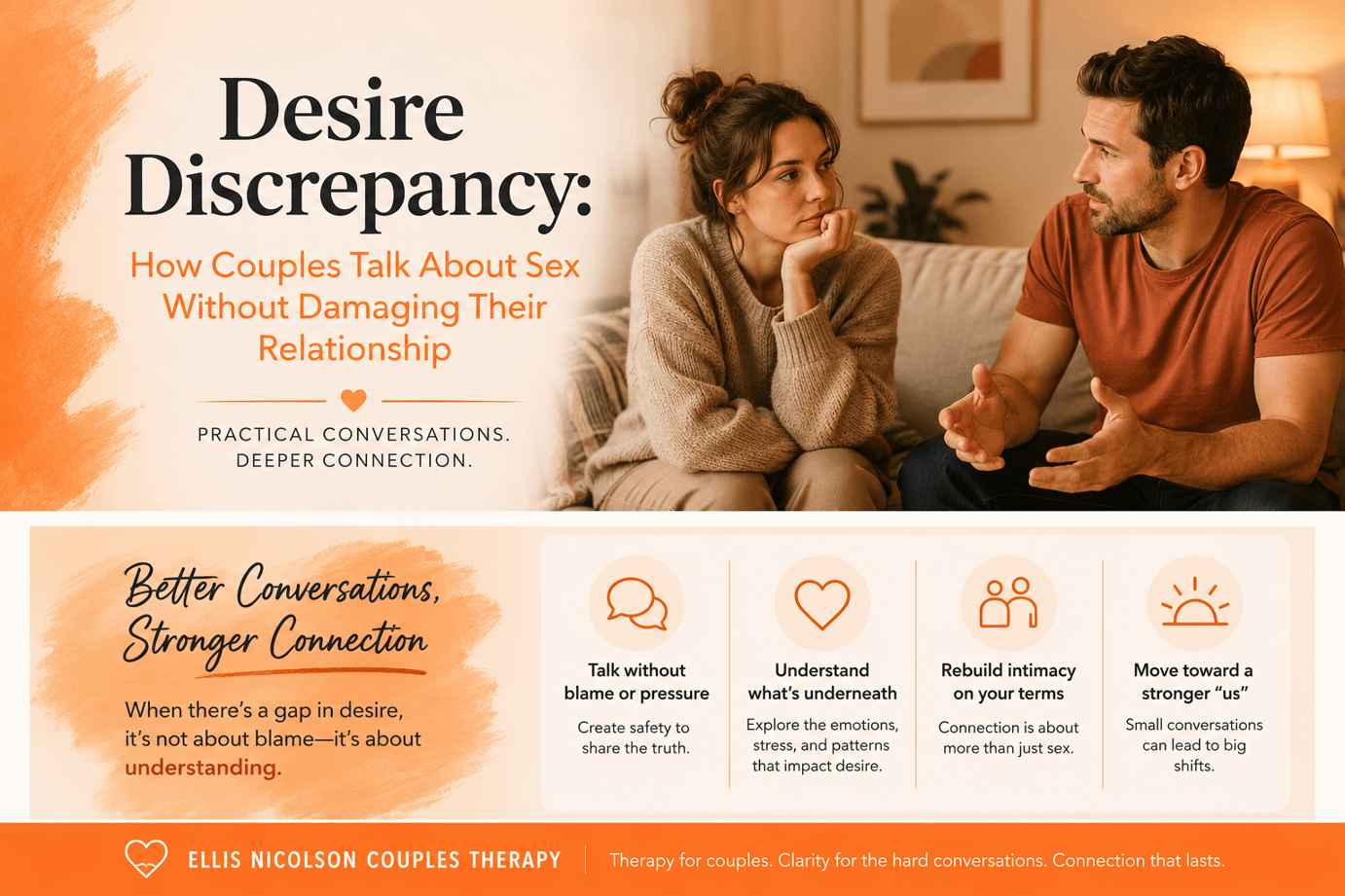
Desire discrepancy happens when partners want sex with different frequency, intensity, or style. In simple terms, the desire discrepancy in relationships is that two partners are not aligned in how often, how intensely, or in what way they want sexual intimacy. It is one of the most common relationship challenges and does not automatically mean the relationship is broken or that attraction is gone forever. Problems usually grow when couples stop talking openly, turn sex into a pressure-filled negotiation, or interpret lower desire as rejection.
Healthy conversations about desire discrepancy in relationships focus on curiosity instead of blame. Couples who handle it well learn to discuss emotional connection, stress, resentment, physical intimacy, and expectations without shaming each other. Emotionally Focused Therapy (EFT) and Gottman-based approaches both emphasize emotional safety, responsiveness, and reducing criticism and defensiveness.
If you feel like you’re “not attracted to your partner anymore,” the issue may involve stress, resentment, burnout, unresolved conflict, hormonal changes, mental health, mismatched libido styles, or emotional disconnection , not necessarily the end of love.
What Is Desire Discrepancy?
Desire discrepancy refers to a mismatch in sexual desire between partners. Desire discrepancy in relationships is common, especially in long-term partnerships where stress, emotional disconnection, life transitions, and different desire styles can affect intimacy. One person may want sex more often, initiate more frequently, or prioritize physical intimacy differently than the other. Another partner may still value closeness deeply but experience desire more slowly, less often, or only after emotional connection has been re-established.
This mismatch can show up in many forms. For one couple, it may mean one partner wants sex several times a week while the other feels comfortable with much less frequent intimacy. For another, it may mean one person wants more emotional buildup before sex, while the other experiences desire more spontaneously. Some couples struggle because affection starts to feel loaded with expectation, while others begin avoiding the topic altogether because every conversation turns painful.
Sexual desire discrepancy is extremely common in long-term relationships. Most couples experience it at some point due to stress, parenting, aging, hormonal shifts, health issues, changing schedules, emotional injuries, or evolving attraction patterns.
The real issue is usually not the discrepancy itself.
The deeper problem is how couples interpret and communicate about it.
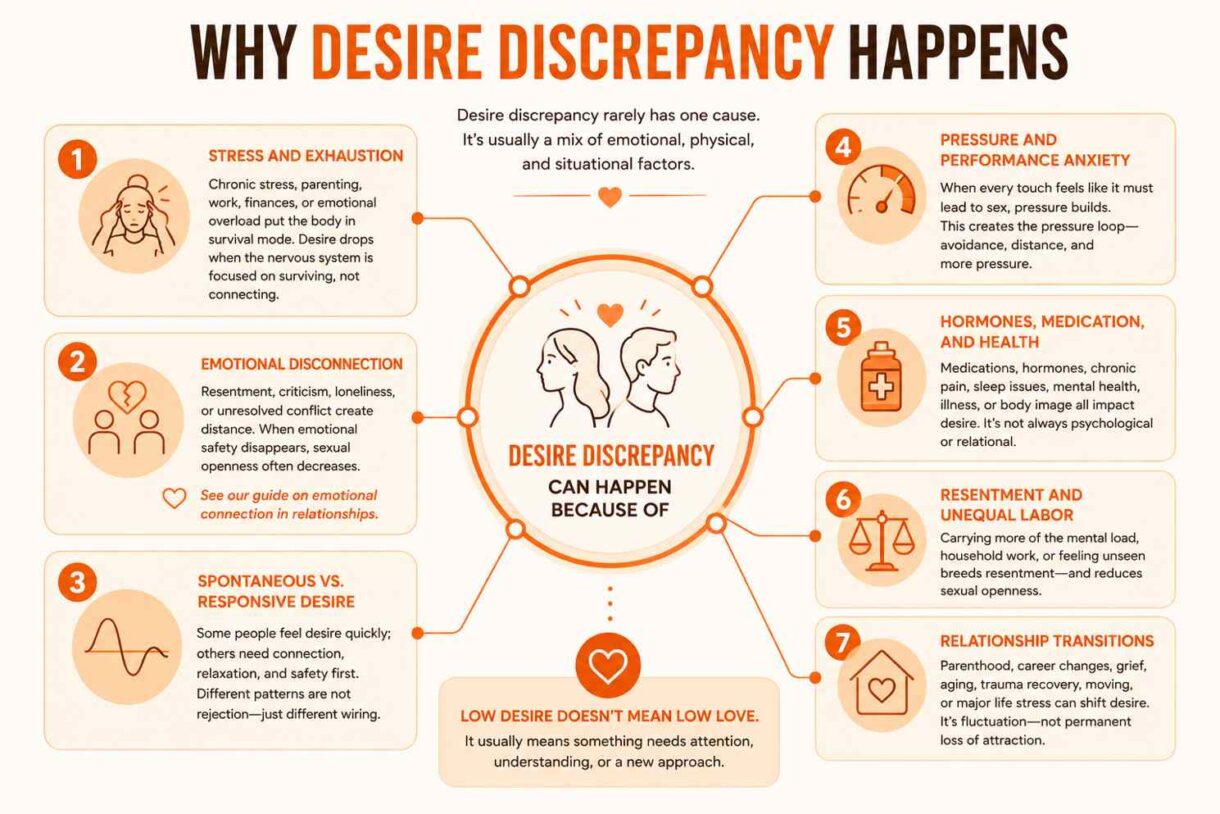
Why Desire Discrepancy Happens?
Many people assume low desire means something catastrophic: “My partner isn’t attracted to me anymore,” “Something is wrong with our relationship,” “We’re becoming roommates,” or “If they loved me, they would want sex more.”
Sometimes attraction has changed, and that deserves honest attention. But often, desire discrepancy has multiple overlapping causes. Understanding those causes helps couples move away from blame and toward a more accurate conversation.
1. Stress and Exhaustion
Chronic stress is one of the biggest desire suppressors.
When someone feels overwhelmed by work, parenting, finances, caregiving, or emotional labor, the nervous system shifts into survival mode. Sexual desire often drops because the body prioritizes safety and recovery over pleasure. A partner who seems “uninterested” may actually be depleted, overstimulated, or emotionally maxed out.
2. Emotional Disconnection
Many people need emotional closeness to feel sexually open.
If unresolved resentment, criticism, loneliness, or conflict builds up, desire can decrease even when love still exists. This is especially common when partners stop feeling emotionally understood. Sex may start to feel vulnerable in a way that no longer feels safe.
For more on rebuilding emotional closeness, see our guide on emotional connection in relationships.
3. The Difference Between Spontaneous and Responsive Desire
Some people experience spontaneous desire, where sexual interest appears naturally and quickly. Others experience responsive desire, where interest develops after affection, relaxation, safety, flirting, or physical closeness begins.
Couples often mistake these different desire patterns as rejection. The spontaneous-desire partner may think, “If you wanted me, you’d already feel turned on.” The responsive-desire partner may think, “I need connection first, not pressure.” Both experiences are valid, but they require different kinds of communication.
4. Pressure and Performance Anxiety
If every touch feels like it must lead to sex, lower-desire partners may begin avoiding affection entirely. Over time, even cuddling, kissing, or flirting can start to feel risky because it might create an expectation they are not ready to meet.
This creates a destructive cycle called the pressure loop.
5. Hormones, Medication, and Health
Desire can change because of antidepressants, birth control, testosterone or estrogen changes, menopause, chronic pain, sleep problems, anxiety, depression, body image struggles, illness, or recovery. Low desire is not always psychological, and it is not always relational.
For some couples, a medical conversation is just as important as an emotional one.
6. Resentment and Unequal Relationship Labor
When one partner feels emotionally unsupported or overburdened, resentment often reduces sexual openness. This can happen when one person carries most of the household responsibilities, manages most of the emotional labor, or feels affection only appears when sex is wanted.
In these cases, the sexual issue may actually be pointing toward a deeper imbalance in the relationship.
7. Relationship Transitions
Desire naturally fluctuates during parenthood, career changes, grief, moving, aging, trauma recovery, long-distance periods, and major life stress. Fluctuation does not automatically mean attraction is permanently gone.
It may mean the relationship needs a new rhythm.
The Pressure Loop: Why Conversations About Sex Go Wrong
One of the most damaging patterns in desire discrepancy is the pressure loop.
The pressure loop usually begins when one partner feels rejected or lonely. In response, they may pursue more sex, reassurance, or proof that they are still wanted. The other partner then feels pressured, inadequate, or emotionally cornered. They withdraw physically or emotionally, which makes the first partner feel even more rejected. The more one partner pursues, the more the other avoids. The more one avoids, the more the other panics.
Eventually, both partners are hurting, but each person sees the other as the problem.
The higher-desire partner may feel unwanted, undesirable, and emotionally abandoned. The lower-desire partner may feel unsafe, pressured, and afraid of disappointing their partner. Affection becomes tense. Conversations become defensive. Sex starts feeling less like connection and more like a performance review.
This cycle is central in Emotionally Focused Therapy (EFT)
EFT views the issue not as “one person is wrong,” but as a negative interaction pattern where both partners become trapped in fear and protection. The pursuing partner often fears abandonment or emotional disconnection. The withdrawing partner often fears failure, pressure, criticism, or loss of autonomy.
Neither person is the enemy.
The cycle is.
How to Deal With Desire Discrepancy Without Damage
Couples often wait too long before discussing intimacy. By the time they talk, the conversation is already emotionally charged.
The goal is not to “win” the conversation.
The goal is to create emotional safety so honesty becomes possible. For couples wondering how to deal with desire discrepancy, the first step is usually not a sexual technique , it is learning how to talk about desire without blame, pressure, or shutdown.
Desire Discrepancy Solutions: An 8-Step Conversation Framework
1. Choose the Right Time
Do not bring up sex during rejection, right after an argument, in bed immediately after conflict, or when someone is exhausted or distracted. Those moments usually make both people more reactive.
Pick a neutral moment when both partners feel calm enough to listen. A better opening might be, “Can we make time this weekend to talk about intimacy in a way that feels caring rather than pressured?”
2. Lead With Vulnerability Instead of Criticism
Criticism triggers defensiveness. Statements like “You never want sex anymore” or “You don’t care about me” may express real pain, but they often land as accusation.
Try leading with the softer truth underneath: “I miss feeling close to you,” “I’ve been feeling lonely and disconnected,” or “I want us to understand each other better.”
This aligns with Gottman’s idea of a “soft startup,” which reduces escalation.
3. Avoid Mind Reading
It is easy to make painful assumptions during desire discrepancy. You may assume your partner is not attracted to you, only cares about sex, is rejecting you on purpose, or no longer values the relationship.
But assumptions often harden into resentment. Ask questions instead. Curiosity is more productive than interpretation.
4. Talk About Feelings, Not Just Frequency
Frequency conversations alone often fail because they turn intimacy into a number. The deeper conversation is about what sex means emotionally to each person.
Explore emotional closeness, stress, pressure, body image, fatigue, safety, resentment, desire style, and what helps intimacy feel natural. A frequency mismatch may be real, but the emotional meaning underneath it is often what causes the most pain.
5. Validate Before Solving
Validation does not mean agreement. It means acknowledging emotional reality.
You might say, “I understand why you feel pressured,” “I can see why rejection hurts,” or “That makes sense to me.” When people feel understood, they become less defensive and more open to problem-solving.
6. Separate Affection From Obligation
Many couples unintentionally train each other to avoid touch. If affection always escalates toward expectation, relaxed closeness disappears.
Create space for nonsexual touch, cuddling, flirting, and physical affection that does not have to become sex. This helps the lower-pressure partner relax and helps the higher-desire partner receive closeness without turning every moment into a test.
7. Discuss What Desire Actually Needs
Instead of asking only, “How often should we have sex?” ask better questions: “What helps you feel emotionally open?” “What makes intimacy harder lately?” “What kind of touch feels good right now?” “What shuts desire down?” “What makes you feel connected?”
These questions shift the conversation from blame to collaboration.
8. Revisit the Conversation Regularly
One conversation rarely solves everything. Desire changes as life changes, and couples need room to keep adjusting.
Healthy couples treat intimacy as an ongoing dialogue rather than a pass/fail test.
10 Scripts for Couples With Desire Discrepancy
These scripts are designed for couples with desire discrepancy who want to talk about sex more safely. Scripts can help when emotions run high. The goal is not to sound rehearsed, but to give yourself language that lowers defensiveness.
1. When You Feel Rejected
“I know you may not mean to hurt me, but I’ve been feeling disconnected lately and I miss feeling close to you.”
2. When You Feel Pressured
“I care about us deeply, but lately intimacy has started to feel stressful instead of connecting for me.”
3. When You’re Afraid Attraction Has Changed
“I’ve been worrying that we’re drifting apart physically, and I want to talk about it honestly instead of making assumptions.”
4. When Stress Is Affecting Desire
“My brain feels overloaded lately, and it’s affecting my ability to feel present and open sexually.”
5. When You Want More Affection
“I miss physical closeness that doesn’t automatically have expectations attached to it.”
6. When Conversations Turn Defensive
“I don’t want this to become about blame. I want us to understand what’s happening together.”
7. When You Need Reassurance
“I think part of this is triggering insecurity for me, and reassurance would help me feel safer.”
8. When You Need Slower Intimacy
“I think I need more emotional connection and buildup before I can feel genuine desire.”
9. When You Want to Rebuild Intimacy Gradually
“Can we focus on rebuilding closeness first instead of trying to immediately fix everything sexually?”
10. When You Want Professional Support
“I don’t think either of us is failing. I think we may need better tools, and therapy could help us communicate differently.”
Do and Don’t List
A helpful rule of thumb: approach desire discrepancy as a shared relationship pattern, not as one partner’s defect. The more safety you create, the more honest the conversation can become.
Do
Use calm, direct language. Talk outside the bedroom. Stay curious instead of accusatory. Discuss emotional context, not just frequency. Validate your partner’s experience before trying to solve the issue.
It also helps to focus on teamwork instead of fault, maintain nonsexual affection, revisit conversations consistently, recognize that desire changes over time, and seek help before resentment becomes entrenched.
Don’t
Do not shame your partner, keep score, demand reassurance repeatedly, or treat sex as the only proof of love. These patterns usually increase relationship anxiety rather than closeness.
Avoid sarcasm, contempt, threats, and pressure. Try not to assume low desire means no attraction, and do not interpret every rejection as a statement about your worth. Desire discrepancy is painful, but it becomes more damaging when partners turn pain into blame.
What If You Feel “Not Attracted to Your Partner Anymore”?
Many people quietly search phrases like “I am not attracted to my partner anymore,” “not attracted to my partner anymore,” “not attracted to partner anymore,” because they feel scared, guilty, confused, or alone. This fear is more common than many couples admit.
Sometimes attraction genuinely changes, and that reality deserves compassion and honesty. But not being attracted to your partner anymore does not always mean the relationship is over. Often, people confuse emotional exhaustion, chronic resentment, stress overload, pressure dynamics, unresolved conflict, lack of novelty, anxiety, depression, or burnout with permanent loss of attraction.
Long-term attraction is rarely automatic. If you are thinking, “I’m not attracted to my partner anymore,” “why am I not attracted to my partner anymore,” “why am I not sexually attracted to my partner anymore,” or “am I not attracted to my partner anymore,” it may help to look beyond the surface question of chemistry. Attraction usually depends on emotional safety, mutual responsiveness, playfulness, respect, curiosity, reduced resentment, physical affection, and feeling desired rather than demanded.
Many couples rediscover attraction after improving emotional connection and communication patterns. This can be true even when someone feels not physically attracted to partner anymore.
Some people also notice a confusing split between emotional and physical connection. They may think things like “I like him but I’m not attracted to him,” “I love my wife but not sexually attracted to her,” or “love my girlfriend but not sexually attracted anymore.” These experiences can feel alarming, but they are more common in long-term relationships than many couples realize.
You can also explore our guide on how to improve your sex life in a long-term relationship.
EFT and Gottman Approaches to Desire Discrepancy
Emotionally Focused Therapy views desire problems as attachment problems rather than simple libido mismatches.
The focus becomes understanding underlying fears, identifying the pursue-withdraw cycle, creating emotional safety, increasing responsiveness, and helping partners feel emotionally secure.
In EFT, the question is not: “Who is causing this?”
The question is: “What vulnerable emotions are trapped underneath this pattern?”
Gottman Perspective
The Gottman Method focuses heavily on communication habits.
For desire discrepancy, several Gottman concepts are especially useful. Soft startups help couples begin difficult conversations gently instead of with criticism. Turning toward means responding to small bids for connection rather than ignoring or dismissing them. Avoiding the Four Horsemen , criticism, defensiveness, contempt, and stonewalling , protects the relationship from patterns that make intimacy feel unsafe.
Gottman work also emphasizes friendship and emotional intimacy. Couples with stronger friendship foundations generally navigate desire differences more successfully because they have more goodwill, trust, and emotional responsiveness to draw from.
When to Seek Couples Therapy?
Many couples wait until resentment becomes severe before getting support. Therapy can be especially helpful when conversations about sex always become arguments, one partner feels chronically rejected, one partner feels persistently pressured, emotional intimacy has collapsed, or sex has become emotionally unsafe.
It is also wise to seek support if there has been infidelity, betrayal, trauma, long-term avoidance, or if you cannot discuss attraction honestly without the conversation breaking down.
A therapist trained in EFT, Gottman Method, or sex therapy can help couples interrupt destructive cycles and rebuild emotional safety. If you are specifically searching for sex therapy desire discrepancy support, look for a therapist who is comfortable discussing sexual intimacy, emotional attachment, communication patterns, and the pressure loop together. Seeking help early is often easier than repairing years of accumulated hurt.
FAQ About Desire Discrepancy
Is desire discrepancy normal?
Yes. Most long-term couples experience mismatched desire at some point. Differences in libido are common and do not automatically mean the relationship is unhealthy.
Many people who search questions like “is it normal to not feel attracted to my partner anymore?” are actually experiencing a very common relationship pattern rather than a permanent relationship failure.
Does low desire mean my partner is not attracted to me?
Not necessarily. If you are worried “my partner not attracted to me anymore,” it is understandable to feel hurt or insecure. But stress, resentment, mental health, hormones, pressure, exhaustion, and emotional disconnection can all reduce desire even when attraction still exists.
Can attraction come back in a relationship?
Often, yes. Many couples rebuild attraction after improving emotional connection, reducing resentment, and creating safer communication patterns. If you are thinking “why am I not sexually attracted to my partner anymore,” “I am not sexually attracted to my partner anymore,” or “not sexually attracted to partner anymore,” it may be worth exploring the emotional, physical, medical, and relational context before assuming attraction is permanently gone.
What is the pressure loop in sexual desire discrepancy?
The pressure loop happens when one partner pursues intimacy more intensely while the other withdraws due to feeling pressured or emotionally unsafe. The cycle increases disconnection for both people.
Should couples schedule sex?
Scheduled intimacy works well for some couples because it reduces uncertainty and creates intentional connection. For others, it feels too structured. The key is collaboration rather than obligation.
How do I talk about sex without hurting my partner when dealing with desire discrepancy?
Use vulnerability instead of criticism. Focus on emotional experience, ask questions, validate feelings, and avoid blame-heavy language.
What if one partner never wants sex?
Persistent low desire may involve medical, emotional, relational, or psychological factors. Honest discussion and professional support can help clarify what is happening.
Can couples therapy help with desire discrepancy?
Yes. Therapies like EFT, Gottman Method, and sex therapy can help couples understand emotional dynamics, improve communication, and rebuild intimacy.
Work Through Desire Discrepancy With Ellis Nicolson’s Couples Therapy
Desire discrepancy is not proof that a relationship is doomed. What matters most is whether couples can discuss intimacy without shame, blame, pressure, or emotional withdrawal.
When conversations become safer, honesty becomes easier. When honesty becomes easier, couples are more likely to understand the real problem underneath the conflict. Sometimes the issue is attraction. Sometimes it is stress, resentment, loneliness, exhaustion, fear, or emotional disconnection.
At Ellis Nicolson Couples Therapy, we help couples slow down painful cycles, understand what each partner is really feeling, and rebuild the emotional safety needed for intimacy to feel possible again. Using evidence-informed approaches such as EFT and Gottman-informed couples work, therapy can help you move from blame and avoidance toward clarity, connection, and repair. For couples searching for sex therapy desire discrepancy support, this kind of therapy can offer a structured, compassionate space to address both the sexual and emotional layers of the issue.
If desire discrepancy has become a recurring source of hurt in your relationship, couples therapy can give you a safer place to talk about sex, attraction, pressure, rejection, and emotional closeness , without turning the conversation into another fight.
Reach out to begin rebuilding connection, communication, and intimacy with more care and less damage.