





Performance anxiety during intimacy is common and treatable. It usually happens when fear, self-monitoring, stress, or pressure interrupt emotional and physical connection. The most effective ways to overcome performance anxiety during sex include:
- Reducing pressure to “perform”
- Identifying anxious thoughts and replacing them with balanced ones
- Using gradual exposure to intimacy without rushing
- Improving communication with your partner
- Focusing on connection instead of outcomes
- Managing stress and nervous system activation
- Seeking professional support when anxiety becomes persistent
Performance anxiety is not a personal failure or proof that something is “wrong” with you. In many cases, it is a learned anxiety response that can be changed with practical tools, patience, and support.
TL;DR: The definition of performance anxiety is an intense fear, pressure, or worry related to needing to “perform well” or avoid failure in situations where someone feels emotionally or physically evaluated. In intimate relationships, performance anxiety often involves fear of disappointing a partner, difficulty relaxing, or becoming overly focused on performance instead of connection.
What Is Performance Anxiety in Intimacy?
Performance anxiety refers to fear, worry, or pressure related to sexual or intimate experiences. A person may become preoccupied with whether they will “perform well,” satisfy a partner, maintain arousal, feel confident, or avoid embarrassment.
Although performance anxiety is often associated with physical symptoms, the issue is usually rooted in stress, self-judgment, fear of rejection, perfectionism, or previous negative experiences.
Common performance anxiety symptoms include racing thoughts, muscle tension, rapid heartbeat, shallow breathing, difficulty staying present, panic, avoidance of intimacy, and fear of embarrassment or rejection. For some people, these performance anxiety disorder symptoms can become persistent and begin affecting relationship confidence and emotional wellbeing.
People experiencing performance anxiety may notice:
- Racing thoughts during intimacy
- Difficulty staying present
- Overanalyzing bodily responses
- Avoiding intimacy altogether
- Increased tension or panic
- Shame or self-criticism afterward
- Fear of disappointing a partner
Performance anxiety can affect people of any gender, age, orientation, or relationship status.
If anxiety regularly interferes with closeness or emotional safety, it may help to explore support through anxiety therapy.
How to break the cycle of performance anxiety?
One reason performance anxiety becomes persistent is because anxiety tends to create a self-reinforcing cycle.
Step 1: Anticipation and Pressure
Before intimacy even begins, a person may start worrying:
- “What if it happens again?”
- “What if I disappoint my partner?”
- “What if they think I’m unattractive?”
- “I need to get everything right.”
The brain interprets these thoughts as threats.
Step 2: Physical Anxiety Activation
The nervous system responds with stress symptoms such as:
- Muscle tension
- Rapid heartbeat
- Shallow breathing
- Difficulty relaxing
- Mental distraction
This stress response makes it harder to feel emotionally connected or physically comfortable.
Step 3: Increased Self-Monitoring
Instead of focusing on connection, pleasure, or emotional presence, attention shifts inward:
- “Am I doing okay?”
- “Do I look nervous?”
- “What if I lose confidence?”
This hyperfocus increases anxiety even more.
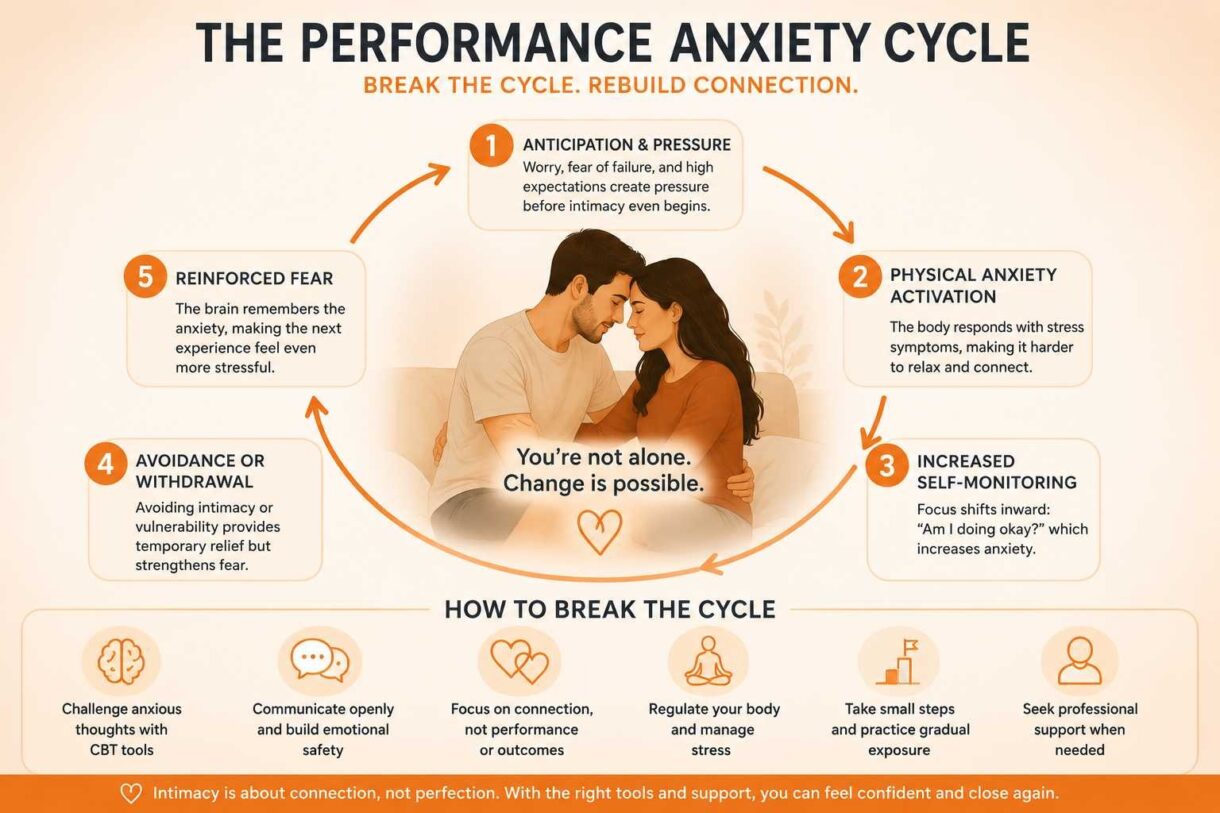
Step 4: Avoidance or Withdrawal
Some people begin avoiding intimacy, emotional vulnerability, dating, or affectionate touch to prevent uncomfortable feelings.
While avoidance may reduce anxiety temporarily, it strengthens the belief that intimacy is dangerous or threatening.
Step 5: Reinforced Fear
The next intimate experience feels even more stressful because the brain remembers previous anxiety.
Over time, this cycle can damage confidence, emotional connection, and relationship satisfaction.
The good news is that this cycle can be interrupted.
What Are the Most Effective Ways to Overcome Performance Anxiety During Sex?
There is no single solution that works instantly for everyone. However, research-supported approaches from cognitive behavioral therapy (CBT), mindfulness, communication skills, and gradual exposure can significantly reduce performance anxiety over time.
Shift the Goal From Performance to Connection
One of the biggest drivers of anxiety is the belief that intimacy must meet a certain standard.
People often treat intimacy like a test:
- “I need to impress my partner.”
- “I have to avoid mistakes.”
- “Everything has to go perfectly.”
This creates pressure instead of connection.
A healthier approach is to redefine intimacy as:
- Shared experience
- Emotional closeness
- Curiosity
- Playfulness
- Communication
- Mutual comfort
When the goal becomes connection instead of perfection, anxiety often decreases naturally.
You can also strengthen long-term intimacy by focusing on emotional connection.
Cognitive behavioral therapy for sexual performance anxiety
Cognitive behavioral therapy for sexual performance anxiety helps people identify anxious thoughts, reduce avoidance behaviors, regulate stress responses, and rebuild confidence during intimacy. CBT is one of the most effective therapeutic approaches for reducing performance anxiety long term.
How does cognitive behavioral therapy address performance anxiety?
Cognitive Behavioral Therapy (CBT) helps address performance anxiety by identifying and changing the anxious thoughts, self-pressure, and avoidance behaviors that fuel fear during intimacy. Many people with performance anxiety become trapped in cycles of overthinking, self-monitoring, and fear of judgment, which increases stress and emotional disconnection. CBT helps individuals challenge unhelpful thoughts such as “I need to perform perfectly” or “I’m going to disappoint my partner,” replacing them with more balanced and realistic perspectives. It also focuses on reducing avoidance, improving emotional regulation, and helping people gradually rebuild confidence and comfort in intimate situations. Over time, CBT can help reduce anxiety, improve communication, and strengthen emotional connection within relationships.
Common Anxious Thoughts
People with performance anxiety often experience automatic thoughts such as:
- “I’m going to fail.”
- “My partner will judge me.”
- “I need to control everything.”
- “If I feel anxious, the experience is ruined.”
- “I should always feel confident.”
These thoughts increase stress and self-monitoring.
Balanced Replacement Thoughts
Instead of trying to force “positive thinking,” CBT encourages realistic and compassionate alternatives.
Examples include:
| Anxious Thought | Balanced Thought |
| “I have to perform perfectly.” | “Connection matters more than perfection.” |
| “If I feel anxious, everything will go wrong.” | “Anxiety is uncomfortable, but it does not define the experience.” |
| “My partner will reject me.” | “Healthy relationships include communication and understanding.” |
| “I should never feel nervous.” | “Many people feel nervous during intimacy sometimes.” |
Practicing these reframes repeatedly helps retrain the brain’s threat response.
Behavioral CBT Strategies
CBT also focuses on behaviors that maintain anxiety.
Reduce Avoidance
Avoidance teaches the brain that intimacy is unsafe.
Small steps toward connection help rebuild confidence.
Examples might include:
- Spending more time cuddling or kissing
- Practicing emotional vulnerability
- Having honest conversations about anxiety
- Allowing affectionate touch without pressure
- Staying present instead of withdrawing
Stop Constant Self-Evaluation
People with performance anxiety often mentally “grade” themselves during intimacy.
Instead, gently redirect attention toward:
- Physical sensations
- Breathing
- Emotional closeness
- Eye contact
- Shared enjoyment
This reduces hypervigilance.
Build Stress Regulation Skills
General stress management matters because anxiety outside the bedroom often affects intimacy too.
Helpful strategies include:
- Deep breathing
- Exercise
- Better sleep
- Limiting alcohol overreliance
- Mindfulness practices
- Relaxation techniques
For more support around stress-related intimacy challenges, explore resources on improving your sex-life.
Understanding Graded Exposure
Graded exposure is a CBT-based approach that helps people slowly face anxiety-provoking situations in manageable steps.
The goal is not to force uncomfortable experiences. Instead, it helps the brain learn that closeness and vulnerability are not dangerous.
How Graded Exposure Works
Rather than jumping directly into high-pressure situations, couples gradually rebuild comfort and confidence.
A progression might involve:
- Spending relaxed time together without expectations
- Increasing non-sexual affection and touch
- Practicing open communication about anxiety
- Focusing on comfort and emotional safety
- Gradually reintroducing intimacy at a manageable pace
The key principle is consistency without overwhelming pressure.
Over time, repeated safe experiences weaken the anxiety response.
How Partners Can Help
A supportive partner can make a major difference in reducing performance anxiety.
The most helpful relationships create emotional safety instead of pressure.
Helpful Partner Responses (DO)
Do Normalize Anxiety
Saying things like:
- “We don’t have to rush.”
- “We’re in this together.”
- “You don’t need to be perfect.”
can reduce shame and fear.
Do Focus on Emotional Connection
Prioritize closeness, affection, communication, and comfort instead of outcomes.
Do Encourage Open Communication
Create space for honest conversations without criticism.
Do Stay Patient
Progress often happens gradually.
Supportive patience helps reduce pressure and rebuild trust.
Unhelpful Partner Responses (DON’T)
Don’t Criticize or Mock
Even joking comments can intensify shame and avoidance.
Don’t Demand Reassurance Constantly
Pressure to “prove” attraction or confidence can worsen anxiety.
Learn the difference between reassurance and anxiety by reading our article
Don’t Turn Intimacy Into a Test
Statements that imply success or failure increase performance pressure.
Don’t Assume Anxiety Means Lack of Attraction
Performance anxiety is often stress-related rather than a reflection of desire or emotional connection.
Communication Scripts
Many people struggle to talk about performance anxiety because they fear embarrassment or rejection.
Simple, honest communication often reduces tension significantly.
Script: Starting the Conversation
“I’ve been feeling anxious during intimacy lately, and I think the pressure is making it harder for me to relax. I want us to feel connected, and I’d like us to work on this together.”
Script: Reassuring a Partner
“This anxiety is not about lack of attraction or caring about you. I think I’m getting stuck in my head and putting too much pressure on myself.”
Script: Slowing Things Down
“Can we focus on being close without putting pressure on ourselves right now?”
Script: Asking for Support
“It would help me if we could approach intimacy more slowly and focus on comfort instead of expectations.”
Performance Anxiety Frequently Asked Questions
1. Is performance anxiety common?
Yes. Many people experience performance anxiety at some point in their lives, especially during periods of stress, relationship changes, low confidence, or after difficult experiences.
2. Can stress outside the relationship cause performance anxiety?
Absolutely. Work stress, burnout, financial pressure, sleep deprivation, and general anxiety can all affect intimacy.
3. Does performance anxiety mean someone is not attracted to their partner?
No. In many cases, performance anxiety occurs despite strong attraction and emotional connection.
4. Can avoiding intimacy make anxiety worse?
Yes. Avoidance may reduce anxiety temporarily, but it often strengthens fear in the long term.
5. How long does it take to overcome performance anxiety?
The timeline varies. Some people improve within weeks, while others need longer-term support. Consistency and reduced pressure are important.
6. Can perfectionism contribute to performance anxiety?
Yes. Perfectionism often increases self-monitoring, fear of mistakes, and pressure during intimate experiences.
7. Does communication really help?
In many relationships, open communication reduces misunderstanding, shame, and emotional distance.
8. Should couples seek therapy together?
Sometimes. Individual therapy can help address anxiety patterns, while couples therapy can improve communication, emotional safety, and relationship dynamics.
9. Why Am I Nervous to Have Sex?
Many people wonder, “Why am I nervous to have sex?” In most cases, the anxiety is not about intimacy itself, but about fear of judgment, pressure to satisfy a partner, body image concerns, past negative experiences, or worries about performance. Stress, burnout, relationship difficulties, and low self-confidence can also increase anxiety during intimacy.
10. What are the most effective therapies for performance anxiety?
The most effective forms of performance anxiety therapy often combine cognitive behavioral therapy (CBT), communication work, mindfulness techniques, gradual exposure strategies, and anxiety management tools. Therapy focuses on reducing pressure, improving emotional safety, changing unhelpful thought patterns, and rebuilding confidence gradually.
11. Natural Ways to Reduce Performance Anxiety
Many people search for natural remedies or cures for performance anxiety before seeking professional support. While there is rarely one instant “cure,” several natural approaches may help calm the nervous system and reduce anxiety during intimacy.
Helpful strategies include:
- Deep breathing exercises
- Better sleep habits
- Mindfulness practices
- Regular exercise
- Reducing alcohol reliance
- Stress management techniques
- Open communication with a partner
Although these approaches may help reduce symptoms, persistent anxiety may still benefit from therapy and professional support.
When to Seek Professional Help?
Occasional anxiety is normal. However, professional support may help if performance anxiety:
- Causes significant distress
- Leads to persistent avoidance
- Damages relationship satisfaction
- Triggers panic or shame
- Creates ongoing conflict with a partner
- Persists despite self-help efforts
- Is connected to trauma, depression, or broader anxiety symptoms
A licensed therapist can help identify underlying thought patterns, emotional triggers, relationship dynamics, and avoidance behaviors contributing to the cycle.
Therapy may include:
- Cognitive behavioral therapy (CBT)
- Anxiety management techniques
- Communication skill-building
- Mindfulness approaches
- Relationship counseling
- Gradual exposure strategies
Seeking help is not a sign of weakness. It is often the most effective step toward rebuilding confidence, comfort, and emotional connection.
You Don’t Have to Navigate Performance Anxiety Alone
Performance anxiety can make intimacy feel stressful, isolating, and emotionally exhausting. But anxiety does not define your worth, your relationship, or your ability to experience closeness.
The most effective ways to overcome performance anxiety during sex usually involve reducing pressure, challenging anxious thinking, rebuilding emotional safety, and practicing gradual connection instead of avoidance.
Small shifts in communication, mindset, and self-compassion can create meaningful progress over time.
Most importantly, intimacy works best when it is approached as a shared human experience — not a performance to perfect.
If performance anxiety is affecting your confidence, relationship, or emotional wellbeing, professional support can help you break the cycle and rebuild connection.
At Ellis Nicolson, our therapists support individuals and couples struggling with anxiety, intimacy difficulties, communication challenges, and emotional disconnection.
Performance Anxiety Counselling Toronto: Book a Consultation
If you’re ready to feel more relaxed, emotionally connected, and confident in your relationship, you can book a consultation with Ellis Nicolson.
Performance Anxiety Related Articles
You may also find these resources helpful:
- The Impact of Technology on Relationships
- How to Enhance Physical Intimacy with Your Partner
- Emotional Connection: Habits That Strengthen Relationships
- Understanding Anxiety in Relationships
You do not need to “perform perfectly” to have a healthy, fulfilling intimate relationship. With the right support, communication, and tools, it is possible to feel safe, connected, and present again.