





Have you ever found yourself in an argument with your partner and wondered, “How did something so small turn into something so big?”
Perhaps it started with a forgotten text message, an offhand comment, a change in tone, or your partner asking a simple question after a long day. Within moments, one of you felt criticized, rejected, ignored, or misunderstood. Voices became louder, or perhaps one person shut down completely. Suddenly, the conversation was no longer about the dishes, arriving home late, or who forgot to call. It felt like you were fighting about something much deeper.
If this sounds familiar, you’re far from alone.
Many couples come to therapy believing they have a communication problem, when in reality they’re caught in a cycle of emotional triggers in relationships. The same situations keep repeating, the same emotions keep surfacing, and both partners leave conversations feeling hurt or confused.
One person may wonder:
“Why do I keep getting triggered in a relationship when I know my partner didn’t mean to upset me?”
Meanwhile, the other may ask:
“Why does my partner react so strongly to things that don’t seem like a big deal?”
These are some of the most common questions therapists hear, and they don’t have simple yes-or-no answers. Human emotions are shaped by our life experiences, our attachment patterns, our nervous system, and the way our brains have learned to interpret emotional safety and danger.
The encouraging news is that relationship triggers don’t have to define your relationship.
Whether you’ve been searching for how to deal with triggers in a relationship, wondering what causes repeated triggers in long-term relationships, or trying to understand how to stop being triggered in relationships, greater awareness is often the first step toward meaningful change.
Ready to Take the First Step?
If recurring arguments, emotional triggers, or communication challenges are affecting your relationship, you don’t have to navigate them alone. At Ellis Nicolson, we help individuals and couples understand the patterns behind conflict and build healthier, more secure relationships.
Ready to get started?
Prefer to learn more first? Continue reading to understand why relationship triggers happen, and what you can do to manage them more effectively.
Throughout this guide, we’ll explore:
- What are triggers in a relationship?
- What are common emotional triggers in romantic relationships?
- Why do small disagreements sometimes feel overwhelming?
- How can you identify your own triggers?
- What are the best ways to handle emotional triggers with a partner?
- When might unresolved trauma or attachment wounds be influencing your reactions?
- When is couples therapy or EMDR worth considering?
By the end of this article, you’ll have a better understanding of what’s happening beneath the surface of recurring conflict and practical strategies for creating calmer, more connected conversations.
TL;DR Relationship triggers are emotional reactions that feel much larger than the present situation because they activate deeper fears, memories, attachment wounds, or unresolved experiences.
When you’re triggered in a relationship, your nervous system often responds as though you’re facing an emotional threat, even if your partner had no intention of hurting you. This is why seemingly small situations can quickly escalate into painful arguments.
The good news is that emotional awareness, nervous system regulation, healthy communication, and evidence-based therapy can all help reduce reactivity over time. Learning to understand your triggers isn’t about avoiding conflict, it’s about responding to conflict in healthier, more intentional ways.
What Are Triggers in a Relationship?
One of the most common questions people ask is: What are triggers in a relationship?
A relationship trigger is anything that activates an intense emotional response because it reminds your brain or nervous system of a previous painful experience.
The important thing to understand is that the trigger itself isn’t necessarily the problem.
Instead, it’s the meaning your brain attaches to that situation.
Imagine touching a bruise.
The touch didn’t create the injury, it simply revealed that the area was already sensitive.
Relationship triggers work much the same way.
A forgotten promise.
A delayed text.
A raised voice.
A partner becoming quiet during an argument.
None of these situations automatically create emotional pain. However, if they resemble experiences that previously felt unsafe, rejecting, or emotionally overwhelming, they can activate much stronger reactions than the current situation alone would normally explain.
This is why two people can experience the exact same interaction in completely different ways.
For example, imagine two partners receive the message:
“Sorry, I’m running late. I’ll call you later.”
One partner thinks:
“No problem, they’re probably busy.”
The other immediately worries:
“Are they upset with me?”
“Did I do something wrong?”
“Are they pulling away?”
The message itself hasn’t changed.
The emotional meaning attached to it has.
Understanding what are triggers in a relationship means recognizing that our reactions are often influenced by both the present moment and our emotional history.
Why Do Relationship Triggers Develop?
Our brains are designed to learn from experience.
Whenever something painful happens repeatedly, or something deeply distressing happens even once, our nervous system begins remembering what preceded that experience.
Its goal is simple:
Protect us from experiencing the same pain again.
This process is incredibly helpful when facing genuine danger.
However, close relationships can become complicated because emotional closeness naturally makes us more vulnerable.
Someone who experienced rejection growing up may become especially sensitive to criticism.
Someone who experienced betrayal may become highly alert whenever communication changes.
Someone who frequently felt ignored as a child may react strongly when their partner seems distracted.
These responses aren’t signs of weakness.
They’re examples of the brain trying to anticipate emotional pain before it happens.
Over time, this protective system can create recurring patterns of being triggered in a relationship, even when the current relationship is loving and supportive.
Why Do Small Things Feel So Big?
One of the most confusing parts of emotional triggers in relationships is that the emotional reaction often seems completely out of proportion to the situation itself.
A forgotten errand becomes a major argument.
A delayed response to a text creates hours of anxiety.
A change in tone feels like rejection.
From the outside, these reactions may appear exaggerated. From the inside, they often feel completely real.
Why?
Because the brain doesn’t simply respond to events, it responds to the meaning those events carry. Imagine someone who spent much of their childhood feeling emotionally invisible, as an adult, their partner glances at their phone while they’re speaking.
Objectively, nothing particularly serious has happened. Perhaps the partner received an urgent work notification. Perhaps they were distracted for only a moment. Yet internally, the experience may feel like:
“I’m not important.”
“No one really listens to me.“
“Here we go again.”
Notice that the emotional reaction isn’t actually about the phone, it’s about what the phone represents.
Relationship anxiety and triggers
This is one of the reasons feeling triggered in a relationship can be so confusing. The present situation acts as a reminder of much older emotional experiences rather than simply reflecting what’s happening in the moment.
The same principle applies to many recurring conflicts in long-term relationships. Someone who has experienced abandonment may become distressed when plans change unexpectedly. Someone who has been criticized throughout life may hear neutral feedback as personal rejection. Someone who has experienced betrayal may interpret uncertainty as evidence that something is wrong.
For some people, these patterns are also closely connected to relationship anxiety. Worrying that your partner is pulling away, overanalyzing text messages, seeking constant reassurance, or fearing rejection can all make emotional triggers feel even more intense. If these experiences sound familiar, you may find it helpful to read our guide on relationship anxiety and how to deal with it, where we explore why relationship anxiety develops and practical strategies for managing it.
Understanding this connection helps explain what causes repeated triggers in long-term relationships. While the argument itself may change, from household responsibilities to communication or desire discrepancy, the underlying emotional theme often remains the same until it is recognized and addressed.
Neurological Emotional Triggers in Relationships: Why Your Brain Reacts Before You Think
Many people assume emotional reactions are purely psychological.
In reality, neurological emotional triggers in relationships play a significant role in how conflict unfolds.
Before you’ve consciously interpreted what’s happening, your brain has already begun asking an important question:
“Am I safe?”
This happens automatically. The emotional centers of the brain continuously scan your environment for signs of danger, rejection, criticism, or abandonment. If something resembles a previous painful experience, your nervous system can activate within fractions of a second. This explains why people often say things like:
“I don’t even know why I reacted like that.”
or
“It felt like my emotions took over.”
In many cases, that’s exactly what happened.
Your thinking brain temporarily stepped into the background while your survival system moved into the foreground. This doesn’t mean you’re irrational. It means your nervous system believes it’s protecting you. Understanding this biological process often helps reduce shame.
Many people criticize themselves for “overreacting.” Instead, it can be more helpful to ask:
“What did my nervous system think it needed to protect me from?”
That question shifts the focus away from self-judgment and toward self-understanding.
Attachment Style Patterns That Create Triggers in Relationships
Our earliest relationships influence how we experience closeness, conflict, reassurance, and emotional safety as adults.
Psychologists refer to these recurring relationship patterns as attachment styles.
While attachment isn’t the only factor influencing emotional reactions, it can help explain why different people experience the same situation so differently.
Anxious Attachment Triggers in Relationships
People with anxious attachment often value closeness very deeply.
Because of earlier experiences of inconsistency, emotional unpredictability, or fear of abandonment, they may become especially sensitive to changes in connection.
Common anxious attachment triggers in relationships include:
- delayed replies to messages
- cancelled plans
- emotional distance
- reduced affection
- uncertainty about where the relationship stands
When these situations occur, the nervous system may quickly interpret them as signs that the relationship is in danger, even when that isn’t the case.
As a result, reassurance often becomes especially important.
Dismissive Avoidant Triggers in Relationships
People with a dismissive-avoidant attachment style often developed independence as a way of coping with emotional stress.
This doesn’t mean they don’t value relationships.
Instead, they may feel overwhelmed when emotional intensity becomes too high.
Common dismissive avoidant triggers in relationships include:
- feeling pressured to talk before they’re ready
- criticism
- feeling controlled
- repeated demands for reassurance
- conflict that feels emotionally overwhelming
When these triggers occur, some people cope by withdrawing, becoming quiet, or creating emotional distance, not because they don’t care, but because that’s how their nervous system has learned to restore a sense of safety.
Recognizing attachment patterns isn’t about placing people into rigid categories.
It’s about understanding why one partner may instinctively seek closeness while the other instinctively seeks space during conflict.
When couples recognize these differences, they often begin replacing blame with empathy.
Instead of asking,
“What’s wrong with you?”
they begin asking,
“What does your nervous system need right now?”
That simple shift can transform the way couples approach difficult conversations and create the emotional safety needed for lasting change.
10 Common Emotional Triggers in Relationships
If you’ve ever searched for a list of 10 emotional triggers in relationships, you may have noticed that most articles simply provide a checklist with little explanation. In reality, understanding why these triggers develop is far more helpful than simply naming them.
Every person brings a unique history into their relationship. Two partners may experience the exact same situation but interpret it in completely different ways because their emotional experiences, attachment histories, and nervous systems are different.
Although every relationship is unique, therapists consistently see certain patterns emerge. These are some of the most common emotional triggers in romantic relationships, along with examples of how they can show up in everyday life.
1. Abandonment
Perhaps the most well-known of all abandonment triggers in relationships is the fear that your partner is pulling away, leaving you, or no longer choosing you.
For someone who has experienced inconsistent caregiving, divorce, betrayal, or previous relationship loss, even relatively ordinary situations can activate this fear.
For example:
- your partner takes longer than usual to reply to a message
- they ask for some time alone
- they seem distracted after work
- plans unexpectedly change
While these situations may be harmless on their own, they can feel emotionally overwhelming when they connect with an older fear of being left behind.
2. Feeling Criticized
Feedback is a normal part of every relationship, but for someone who grew up in a highly critical environment, even gentle suggestions may feel deeply personal.
Instead of hearing:
“Could we try doing this differently?”
their nervous system may hear:
“You’re not good enough.”
This is why some people become defensive almost immediately during conversations that were never intended as criticism.
3. Feeling Ignored
One of the most common emotional triggers in a relationship is the feeling of not being seen or heard.
Perhaps your partner checks their phone while you’re speaking, forgets something important you shared, or seems distracted during an important conversation.
Even if their attention drifted for only a moment, your nervous system may interpret the experience as emotional neglect.
4. Emotional Withdrawal
Some people naturally need quiet time to process emotions.
Others experience silence as emotional danger.
If you’ve previously experienced rejection or emotional abandonment, a partner becoming quiet during conflict may feel much more threatening than they intended.
This is one reason why pursuer-withdrawer dynamics are so common in couples.
One partner moves closer seeking reassurance, while the other creates distance in an attempt to calm themselves.
5. Broken Trust
Trust is built through consistency.
When that consistency has been damaged, whether through dishonesty, betrayal, or repeated disappointments, the nervous system often remains on high alert.
Even after trust begins rebuilding, situations involving uncertainty may continue triggering anxiety until emotional safety has been restored.
6. Feeling Controlled
Many people who grew up in controlling family environments or previous unhealthy relationships become especially sensitive to anything that feels like pressure.
A simple suggestion can unintentionally sound like criticism.
An invitation can feel like a demand.
The emotional reaction often reflects past experiences more than the present conversation.
7. Jealousy and Insecurity
Another of the most common examples of triggers in relationships involves jealousy.
Sometimes jealousy reflects concerns within the current relationship.
Other times it grows from previous betrayal, inconsistent attachment, or fear of not being enough.
We’ll explore this more later in the article when discussing how to manage jealousy and insecurity relationship triggers.
8. Feeling Misunderstood
Many people become emotionally reactive when they believe their intentions have been misunderstood.
Rather than feeling seen, they feel judged.
Instead of explaining themselves calmly, they may become increasingly defensive because their nervous system perceives the misunderstanding as an attack on their character.
9. Rejection
Humans are wired for connection.
Even subtle experiences of rejection, whether real or perceived, can activate surprisingly strong emotional responses.
This doesn’t necessarily mean someone has low self-esteem.
It simply reflects how important close relationships are to our emotional wellbeing.
10. Lack of Emotional Connection
Sometimes there isn’t one specific event causing conflict.
Instead, couples gradually become disconnected through busy schedules, stress, parenting responsibilities, or emotional exhaustion.
When emotional connection decreases, small disagreements often begin carrying much greater emotional weight. Read our guide on how to emotionally connect to your partner for some practical tips.
How to Identify Your Own Triggers in Relationships
After learning about these common patterns, many people ask: How do I identify my own triggers in relationships?
The answer isn’t simply identifying situations that upset you.
Instead, it’s learning to notice the situations that consistently create emotional reactions that feel larger, faster, or more intense than expected.
One helpful question to ask yourself is:
“What does this situation remind me of?”
Notice that the question isn’t:
“What’s wrong with me?”
or
“Why am I overreacting?”
Instead, it encourages curiosity.
Perhaps your partner arriving home late reminds you of waiting for a parent who rarely kept promises.
Perhaps criticism reminds you of constantly trying to earn approval growing up.
Perhaps emotional distance reminds you of feeling alone during difficult moments in childhood.
Understanding these connections doesn’t mean living in the past.
It simply helps explain why certain situations continue affecting you today.
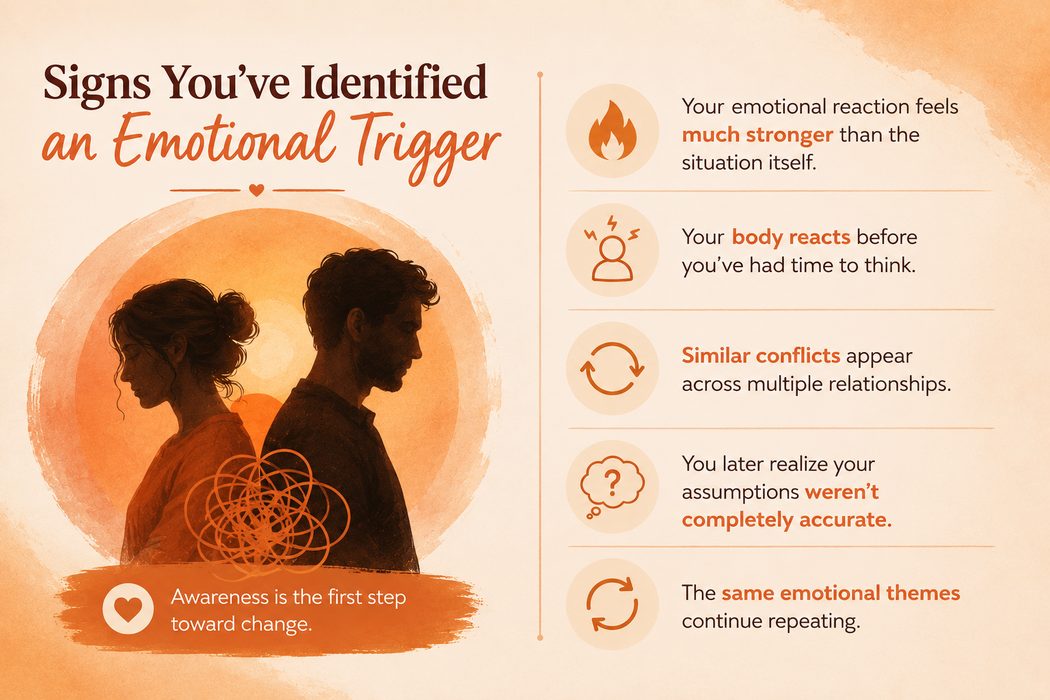
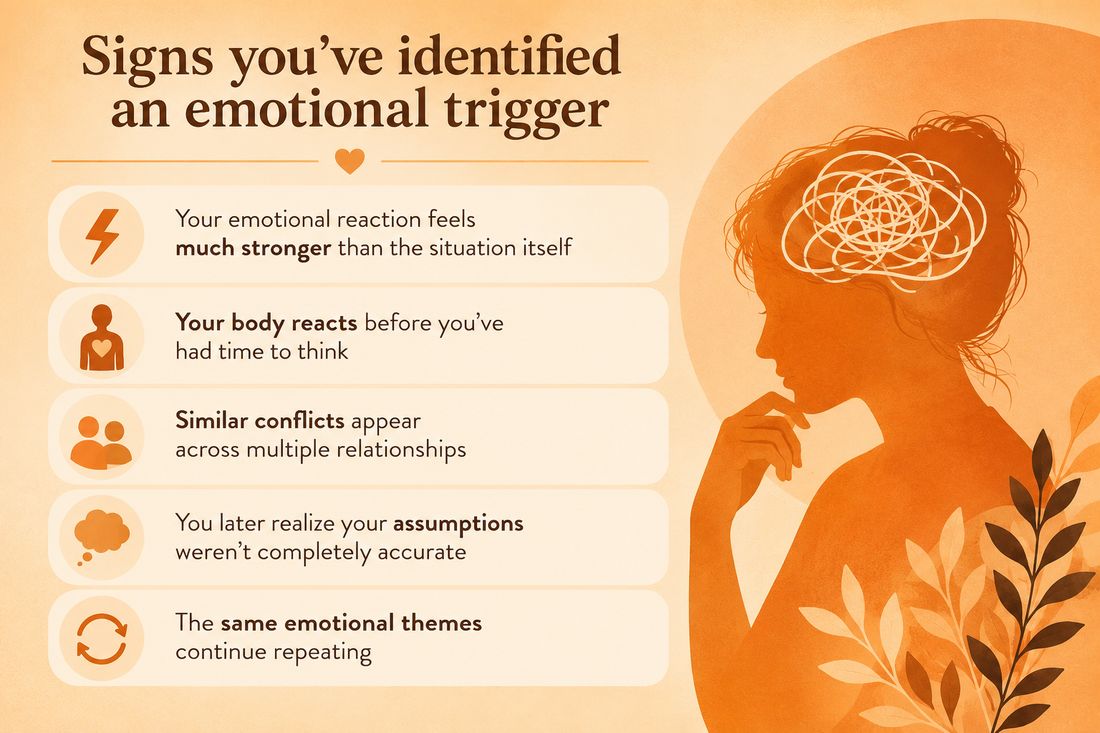
Signs you’ve identified an emotional trigger
You may have identified one of your own triggers in relationships if:
- your emotional reaction feels much stronger than the situation itself
- your body reacts before you’ve had time to think
- similar conflicts appear across multiple relationships
- you later realize your assumptions weren’t completely accurate
- the same emotional themes continue repeating
Developing this awareness is one of the most important steps toward changing recurring relationship patterns.
Signs Your Partner Is Activating Unresolved Relationship Triggers
Sometimes the biggest challenge isn’t recognizing your own reactions.
It’s realizing that your partner may be experiencing an emotional trigger that has little to do with the current conversation.
So what are the signs your partner is activating unresolved relationship triggers?
One of the clearest signs is when the emotional response seems much bigger than the event itself.
For example, your partner may become deeply hurt after a seemingly minor misunderstanding or unexpectedly defensive during an otherwise calm conversation.
While it’s tempting to think,
“They’re overreacting,”
a more helpful question is:
“Could this situation be reminding them of something painful?”
Other signs include:
- they become emotionally flooded very quickly
- the same arguments happen repeatedly
- they struggle to believe reassurance
- their reactions seem rooted in fear rather than anger
- they later describe feeling embarrassed or confused by their own response
Recognizing these patterns doesn’t mean assuming you caused them.
Nor does it mean accepting unhealthy behaviour.
Instead, it creates an opportunity to respond with empathy while still maintaining healthy boundaries.
Trigger or Genuine Relationship Issue?
Understanding emotional triggers is incredibly valuable, but it’s equally important not to use the word trigger to dismiss legitimate relationship concerns.
Many couples worry that if they acknowledge a trigger, they’re somehow saying the issue doesn’t matter.
That’s not the case.
In fact, both things can be true at the same time.
Imagine your partner repeatedly forgets commitments they’ve made. Perhaps this genuinely affects trust in your relationship. At the same time, it may also activate an older fear of abandonment or not being important. The emotional trigger doesn’t erase the real issue. Likewise, the real issue doesn’t invalidate the emotional pain connected to it. A helpful way to think about it is this:
The trigger explains the intensity. The relationship issue explains the conversation that still needs to happen.
Healthy couples learn to address both.
They explore the emotional experience while also taking responsibility for behaviours that affect the relationship.
What Causes Repeated Triggers in Long-Term Relationships?
One question couples frequently ask is: What causes repeated triggers in long-term relationships?
The answer usually isn’t that couples keep finding new things to argue about. More often, they’re replaying the same emotional pattern in different situations. One disagreement might start because someone forgot to send a text message, another because plans changed unexpectedly, and another over parenting, finances, or household responsibilities.
While the topics may appear unrelated, the emotions driving them are often remarkably consistent. One partner may repeatedly experience a fear of rejection or abandonment, while the other becomes increasingly sensitive to criticism or feeling controlled. Without recognizing these deeper emotional themes, couples can spend years trying to resolve the immediate issue without addressing the pattern underneath.
As those recurring themes become clearer, conversations begin to shift. Rather than focusing solely on who forgot what or who said the wrong thing, couples start exploring what those moments represent emotionally. This shift, from reacting to understanding, is one of the most meaningful turning points we see in therapy because it opens the door to empathy, healthier communication, and lasting change.
Trauma Triggers in Relationships: When the Past Keeps Showing Up
Not every emotional trigger is rooted in trauma.
Sometimes stress, poor communication, or unmet relationship needs are enough to create conflict. However, for many people, recurring emotional reactions are connected to experiences that happened long before their current relationship began.
Understanding the difference can be incredibly important.
If you’ve ever found yourself thinking:
- “Why do I keep having the same emotional reaction?”
- “Why does this relationship bring out fears I thought I’d moved past?”
- “How do I deal with trauma triggers in a relationship?”
you’re certainly not alone.
Trauma has a unique way of influencing the present. Even when we logically know we’re safe, our nervous system may still respond as though an old threat is happening again.
What Are Trauma Triggers in Relationships?
Trauma triggers in relationships are situations that activate emotional or physical responses connected to unresolved traumatic experiences.
These experiences don’t have to involve a single catastrophic event.
Trauma can develop after experiences such as:
- emotional neglect during childhood
- chronic criticism
- bullying
- emotional or physical abuse
- sexual abuse
- witnessing violence
- betrayal by a previous partner
- sudden loss or grief
- growing up in an unpredictable or chaotic home
Some people also experience accidental trauma triggers in relationships following serious accidents, medical emergencies, natural disasters, or other life-threatening events. Although these experiences may seem unrelated to romantic relationships, they can influence how safe, vulnerable, or in control someone feels with a partner.
The important point is that trauma changes the way the brain responds to perceived danger.
Rather than recognizing a situation as new, the nervous system may respond as though the original painful experience is happening again.
This is why someone may feel intensely anxious during a disagreement even while knowing their partner is generally kind and supportive.
Healing Childhood Wounds That Create Triggers in Relationships
Many relationship triggers have surprisingly deep roots.
Our earliest relationships teach us what to expect from closeness, conflict, trust, and emotional connection.
If those early experiences were inconsistent, frightening, or emotionally neglectful, the nervous system often adapts by becoming especially alert to signs of rejection or abandonment.
This doesn’t mean your childhood permanently determines your relationships.
Far from it.
However, healing childhood wounds that create triggers in relationships often involves recognizing how those early experiences continue shaping your expectations today.
For example, someone who rarely received comfort as a child may struggle to ask for reassurance as an adult.
Someone who learned that expressing emotions led to criticism may find themselves shutting down during conflict.
These patterns aren’t character flaws.
They’re survival strategies that once served an important purpose.
The encouraging news is that new experiences—including healthy relationships and therapy—can help create new emotional patterns over time.
How to Heal Past Trauma Causing Relationship Triggers
One of the questions people frequently ask is: How do you heal past trauma causing relationship triggers?
The answer depends on the individual, but healing generally involves more than simply understanding where the trigger came from. Insight is valuable. Healing requires experience.
Many people discover that although they understand why they react the way they do, their emotional responses continue happening automatically.
That’s because trauma isn’t stored only as a story we remember.
It’s also stored in the nervous system.
Effective healing often includes:
- increasing awareness of recurring patterns
- learning emotional regulation skills
- developing healthier attachment experiences
- practicing self-compassion
- improving communication with your partner
- working with a trauma-informed therapist when appropriate
Over time, situations that once felt overwhelming often become much easier to navigate. Healing doesn’t erase the past, it changes how much power the past has over the present.
How EMDR Therapy Can Help
When trauma continues affecting present-day relationships, communication skills alone aren’t always enough.
This is where therapies such as Eye Movement Desensitization and Reprocessing (EMDR) may be beneficial.
EMDR is an evidence-based psychotherapy approach designed to help people process distressing memories so they become less emotionally overwhelming.
Rather than reliving painful experiences, clients work with a trained therapist to help the brain process memories that may have become “stuck.”
As those memories become integrated, many people notice that situations which previously activated intense emotional reactions no longer carry the same emotional intensity.
For someone wondering how to deal with trauma triggers in a relationship, EMDR may be an appropriate option when unresolved trauma continues affecting emotional safety, trust, or communication.
If you’d like to learn more, you can read our guide on EMDR therapy and how it supports recovery from trauma-related emotional responses.
Managing Jealousy and Insecurity Relationship Triggers
Jealousy is one of the most misunderstood emotions in relationships.
Many people assume it simply reflects possessiveness or a lack of trust.
In reality, jealousy often develops from a combination of past experiences, attachment patterns, self-esteem, and current relationship dynamics.
When considering how to manage jealousy and insecurity relationship triggers, it’s important to approach these emotions with curiosity rather than shame.
Ask yourself:
- What am I afraid might happen?
- Has this fear appeared in previous relationships?
- Am I reacting to my partner’s behaviour, or to something from my past?
- What reassurance do I genuinely need?
Healthy partners can provide reassurance, consistency, and transparency.
At the same time, lasting emotional security usually develops through both individual growth and a relationship built on trust.
BPD Triggers in Relationships
People living with Borderline Personality Disorder (BPD) often experience emotions more intensely than others, particularly during moments involving perceived rejection, abandonment, or emotional distance.
As a result, BPD triggers in relationships may include situations such as:
- feeling ignored
- cancelled plans
- perceived criticism
- uncertainty about the relationship
- changes in communication
It’s important to remember that no two people experience BPD in the same way.
While the relationship skills discussed throughout this article may be helpful, individuals living with BPD often benefit from personalized treatment approaches, such as Dialectical Behaviour Therapy (DBT), individual psychotherapy, and, in some cases, couples therapy.
If you or your partner identifies with these experiences, working with a qualified mental health professional can provide support tailored to your unique needs.
Couples Therapy Techniques for Managing Triggers in Relationships
Many couples wait until they’re constantly arguing before seeking help.
In reality, therapy is often most effective before conflict becomes deeply entrenched.
Modern couples therapy isn’t about deciding who is right or wrong.
Instead, therapists help couples recognize the emotional patterns beneath recurring disagreements.
Some common couples therapy techniques for managing triggers in relationships include:
- identifying recurring interaction cycles
- improving emotional awareness
- strengthening communication skills
- practicing co-regulation during conflict
- developing healthier repair strategies
- understanding attachment styles
- increasing emotional safety
- learning practical conflict resolution skills
Therapy provides a structured, supportive environment where both partners can slow down recurring conflicts and begin understanding each other’s emotional experiences more deeply.
Ready to Break the Cycle of Reactivity?
If recurring conflict, emotional triggers, or unresolved past experiences are affecting your relationship, you don’t have to work through them alone.
At Ellis Nicolson, we provide compassionate, evidence-based support for individuals and couples throughout Mississauga, Toronto, and across Ontario through secure virtual therapy.
Whether you’re interested in couples therapy, individual psychotherapy, or EMDR therapy for trauma-related triggers, our goal is to help you better understand your emotional patterns, strengthen communication, and build healthier, more secure relationships.
You may also find these resources helpful:
- Understanding the Push–Pull Relationship Cycle
- Anxiety vs Intuition in Relationships: How to Tell The Difference
- Performance Anxiety and Intimacy: Effective Ways to Break the Cycle and Feel Connected Again
If you’re ready to move beyond recurring conflict and build a stronger, more connected relationship, contact us today to schedule a consultation.
Relationship Triggers: Frequently Asked Questions
What are common emotional triggers in romantic relationships?
Some of the most common emotional triggers include feeling ignored, criticized, rejected, controlled, misunderstood, emotionally abandoned, or uncertain about the relationship. Previous experiences and attachment patterns often influence how strongly these situations affect us.
How can I identify my own triggers in relationships?
Notice situations that consistently create emotional reactions that feel larger than expected. Ask yourself what the situation reminds you of and whether similar emotions have appeared in previous relationships or earlier life experiences.
How do I stop being triggered in relationships?
Learning how to stop being triggered in relationships isn’t about eliminating emotions. It’s about recognizing your triggers earlier, regulating your nervous system, communicating openly, and seeking support when needed.
How should I talk about triggers with my partner?
Choose a calm moment rather than the middle of an argument. Describe your experience without blame, explain what you noticed emotionally, invite your partner’s perspective, and work together on practical ways to support one another.
What causes repeated triggers in long-term relationships?
Repeated triggers usually reflect recurring emotional themes rather than recurring problems. Different situations may activate the same underlying fear, such as abandonment, criticism, or rejection, leading couples to experience similar arguments repeatedly.
Can couples therapy help with emotional triggers?
Yes. Couples therapy helps partners understand recurring interaction patterns, improve communication, strengthen emotional safety, and develop healthier responses to conflict.
When is EMDR recommended for relationship triggers?
EMDR may be helpful when emotional reactions are strongly connected to unresolved trauma that continues affecting present-day relationships.
Can healthy relationships reduce emotional triggers over time?
Yes. Safe, supportive relationships often become an important part of healing. Consistent experiences of trust, validation, and emotional safety can gradually help the nervous system develop new expectations about closeness and conflict.